Positioning isn't just about what you say anymore.
It's about how you structure what you say—in a way that both humans and machines can parse, evaluate, and act upon.
When an AI agent evaluates your product, it doesn't read your website the way a human does. It doesn't absorb the mood of your hero image or feel the confidence of your bold typography.
It extracts information, matches claims to requirements, and looks for evidence.
The structure of your content determines what gets extracted—and what gets ignored.
The Message Architecture Framework
Think of agent-aware messaging as a three-layer architecture, where each layer serves a different function in the evaluation process.
Claim Layer: Specific, verifiable assertions. Evidence Layer: Proof points that support each claim. Narrative Layer: The story that ties claims together for human consumption.
Traditional marketing starts with narrative and sprinkles in claims as supporting elements.
Agent-aware messaging starts with claims—structured, specific, verifiable—and builds narrative around them.
Writing Agent-Parseable Claims
A claim is agent-parseable when it contains specific, extractable information that can be matched against buyer requirements.
Quantify Everything Quantifiable
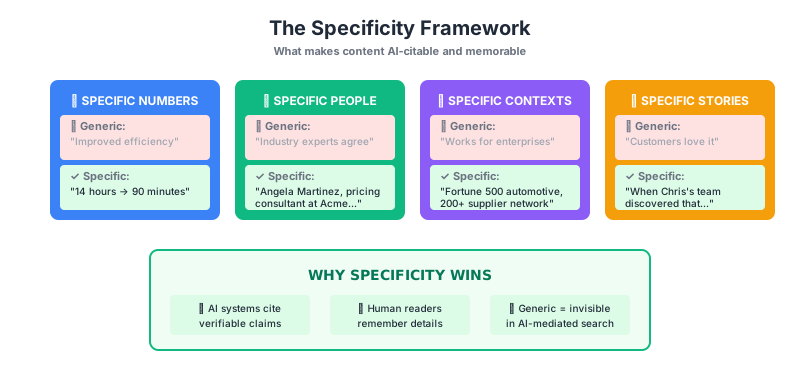
Instead of: "Fast query performance"
Write: "Query response time under 200ms for datasets up to 50TB"
Instead of: "Enterprise-scale reliability"
Write: "99.99% uptime SLA with automatic failover across 3 geographic regions"
Instead of: "Loved by customers"
Write: "4.7/5 average rating across 1,247 verified reviews on G2"
Name Names
Agents trust specificity. Generic references carry less weight than named examples.
Instead of: "Trusted by leading enterprises"
Write: "Deployed at Siemens, Nestlé, and Boeing for production analytics workloads"
Instead of: "Recognized by analysts"
Write: "Named a Leader in the 2026 Gartner Magic Quadrant for Analytics and BI Platforms"
The specificity isn't just for agents. Humans trust it more too. But agents require it—they can't infer what "leading" means the way a human might.
Structure for Extraction
The format of your content affects how well agents can extract information from it.
High parseability:
- Comparison tables with clear headers
- Bulleted specification lists
- Structured FAQ sections
- Feature matrices with checkmarks
- Numbered capability lists
Low parseability:
- Claims buried in flowing prose
- Specifications in PDF-only format
- Information locked behind registration walls
- Video-only content with no transcript
- Infographics with embedded text
Building the Evidence Layer
Every major claim needs evidence—and that evidence needs to be accessible.
An agent that encounters "We're the market leader" will look for verification. If it can't find any, it will note the claim as unsubstantiated.
Types of Evidence
Third-party validation: Analyst rankings, awards, certifications, industry recognition. These carry high weight because they're independently verifiable.
Customer proof: Named customer references, published case studies with metrics, review site ratings. Stronger when specific rather than aggregated.
Technical evidence: Benchmark results, security certifications (SOC 2, ISO 27001), compliance attestations, architectural documentation.
Usage data: Transaction volumes, user counts, deployment scale. "Processing 3.2 trillion transactions annually" is evidence. "Massive scale" is assertion.
Evidence that an agent can't access doesn't exist for evaluation purposes. If your best case study is a PDF behind a login, an agent evaluating you for a prospect will never see it.
The Positioning Audit
Before you can build agent-aware messaging, you need to understand what agents currently see when they evaluate you.
Step 1: Run your top 5 product pages through Claude, ChatGPT, and Perplexity with evaluation prompts
Step 2: Document which claims each agent extracted
Step 3: Note which claims were marked as unverified or unclear
Step 4: Identify claims that contradict across different pages
Step 5: List evidence that exists but isn't accessible (PDFs, gated content)
Step 6: Compare what agents cite for you vs. top 2 competitors
This audit typically reveals three categories of issues:
- Missing specificity: Claims that are too vague for agents to extract actionable information
- Missing evidence: Claims that agents flag as unverified because supporting proof isn't accessible
- Coherence gaps: Inconsistencies across content that undermine agent confidence
Maintaining the System
Agent-aware messaging isn't a one-time project. It's an ongoing system that requires maintenance.
Build these habits into your PMM operations:
- Quarterly audit: Re-run the agent visibility audit to catch drift and new gaps
- Evidence refresh: Update proof points as new data becomes available
- Coherence checks: Review new content against the messaging stack before publishing
- Competitive monitoring: Track how agents position you vs. competitors
The PMMs who build these systems now will have a compounding advantage as agent-mediated buying becomes the norm.