The traditional sales enablement model is breaking down.
You create content. You train the sales team. You hope they use it. You discover three months later that half the reps are still using the old deck because it's what they know.
Meanwhile, the buyer has done forty hours of AI-assisted research before the first call. They know your pricing. They know your competitor's positioning. They've read reviews you didn't know existed.
The information asymmetry has flipped—and sales enablement needs to flip with it.
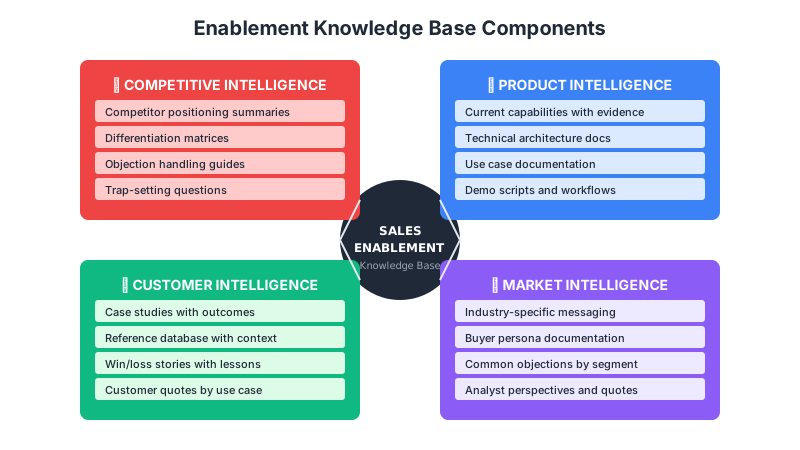
The New Enablement Stack
AI-augmented sales enablement isn't about replacing training with chatbots. It's about three shifts:
From Static Content to Dynamic Assembly
Traditional enablement produces finished artifacts—the pitch deck, the battlecard, the case study library. Reps choose from a menu of pre-made options.
AI-augmented enablement produces components that can be assembled dynamically based on the specific deal context.
The rep doesn't search for "healthcare case study." They describe the deal—mid-market health system, evaluating against Competitor X, concerned about integration complexity—and the system assembles a custom package: relevant case studies, specific competitive positioning, integration documentation tailored to their stack.
From "here's all our content, find what you need" to "tell me about your deal, I'll give you exactly what's relevant."
From Periodic Training to Just-in-Time Learning
Sales kickoff happens once a year. Competitive training happens quarterly. Product updates get announced and promptly forgotten.
AI-augmented enablement delivers learning when it's needed—in the context where it will be used.
The rep is preparing for a call with a prospect who uses Salesforce and is concerned about data privacy. The system surfaces: here's how we integrate with Salesforce, here's our privacy documentation, here's how the last three similar deals handled this objection.
From Guessing to Knowing
Traditional enablement guesses what content reps need based on intuition and occasional feedback. Usage analytics help but lag reality.
AI-augmented enablement learns continuously from deal outcomes. Content that correlates with wins gets surfaced more. Objection handlers that fall flat get flagged for revision. The system gets smarter with every deal.
Building the Intelligence Layer
The practical implementation requires building an intelligence layer between your content and your sales team.
Content Structuring
Your content needs to be machine-readable, not just human-readable. That means:
- Metadata tagging: Every piece of content tagged by industry, company size, competitor, objection type, buyer persona, deal stage
- Modular architecture: Content broken into components that can be recombined, not monolithic documents
- Structured data: Pricing, features, specifications in formats AI can parse and compare
Context Capture
The system needs to know about deals to serve relevant content. That means integration with:
- CRM: Deal stage, company size, industry, competitors involved
- Call intelligence: Objections raised, topics discussed, sentiment patterns
- Email/calendar: Communication patterns, meeting context
Retrieval and Assembly
An AI layer that can:
- Understand natural language queries about deals
- Retrieve relevant content from the structured repository
- Assemble custom packages for specific situations
- Explain why specific content was recommended
The goal isn't to automate the rep out of the equation. It's to give every rep the preparation quality that previously only the best reps achieved—because they have AI doing the research and assembly they used to skip.
The Human Edge
AI-augmented enablement amplifies what makes good reps good. But some things remain irreducibly human:
Relationship intuition. The sense that something is off in a deal. The read on what the buyer really cares about versus what they're saying.
Creative problem-solving. The unconventional approach that wins a stuck deal. The reframe that turns an objection into an opportunity.
Trust building. The authenticity that makes a buyer want to work with you, not just your product.
AI handles the preparation. Humans handle the connection.
The best-enabled reps will be those who use AI to arrive at every interaction fully prepared—and then put the AI away and focus entirely on the human in front of them.