The traditional approach to competitive intelligence looks something like this:
Once a quarter, the PMM team carves out a week to update the battlecards. They pull the latest from competitor websites, check for new analyst reports, maybe run a few demo requests under an alias.
They compile the findings into a deck and a one-pager, push it to the sales team, and move on to the next fire.
Three weeks later, the sales team loses a deal because the competitor launched a new feature that wasn't in the battlecard.
The PMM team didn't know because nobody was watching.
The market moves continuously, but your information updates discretely. In the gaps between updates, you're operating on stale data—and your competitors may be using that gap against you.
The Always-On Alternative
What would it look like if competitive intelligence wasn't a quarterly project but a continuous system?
If the battlecard updated itself when competitors changed their pricing?
If your sales team got alerts when a competitor launched a new feature?
If patterns in win/loss data surfaced automatically instead of waiting for someone to analyze them?
This isn't hypothetical anymore. The combination of AI agents, automated monitoring, and intelligent synthesis makes always-on competitive intelligence not just possible but practical—even for PMM teams of one.
The PMM who builds an always-on competitive intelligence system that monitors fifteen competitors in real time is not just "faster" than the PMM who updates battlecards quarterly. They are operating in a fundamentally different category.
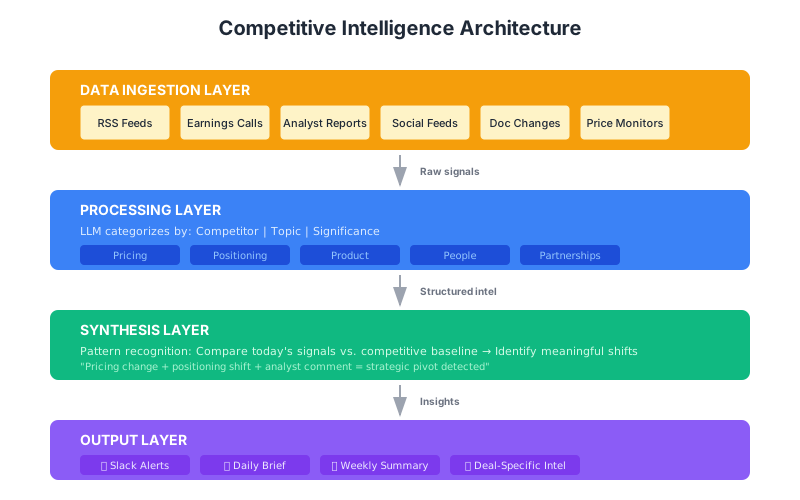
The Four Layers of Continuous CI
Layer 1: Automated Monitoring
The foundation is automated monitoring of competitor signals:
- Website changes: Pricing pages, feature lists, messaging shifts, new product announcements
- Content publishing: Blog posts, case studies, whitepapers, webinars
- Social signals: Company announcements, executive posts, hiring patterns
- Review sites: New reviews on G2, Gartner Peer Insights, TrustRadius
- Job postings: What they're hiring for reveals strategic priorities
- Press and news: Funding rounds, partnerships, executive changes
Layer 2: Intelligent Filtering
Raw monitoring produces noise.
A competitor blog post about their company retreat isn't competitively relevant. A new feature launch is.
The second layer is intelligent filtering—using AI to assess which signals actually matter.
An agent can be trained to evaluate signals against criteria: Does this affect our competitive positioning? Does this change the comparison on key evaluation criteria? Does this create a new objection we'll need to handle?
Layer 3: Automated Synthesis
Filtered signals need to be synthesized into actionable intelligence. An agent can:
- Update the relevant section of a battlecard when a competitor changes pricing
- Generate a briefing note when a competitor launches a major feature
- Compile a weekly digest of competitive movements for the sales team
- Identify patterns across multiple signals that suggest strategic shifts
Layer 4: Distribution and Action
Intelligence is only valuable if it reaches the people who need it when they need it:
- Real-time alerts to sales when a deal-relevant competitor makes a move
- Weekly digests to the broader team summarizing competitive landscape changes
- Automatic battlecard updates pushed to wherever sales accesses them
- Triggers for PMM review when changes exceed certain thresholds
The Living Battlecard
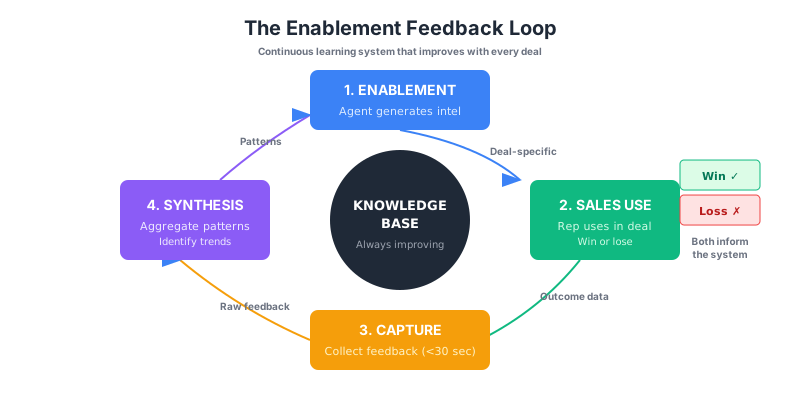
The traditional battlecard is a static document—a snapshot of competitive reality at the moment it was created.
The living battlecard is a dynamic system that updates continuously.
The battlecard isn't a PDF you update quarterly. It's a system that ingests signals, processes them through AI, and outputs current intelligence. The sales rep always sees the latest version because there's only ever one version—the now version.
This requires rethinking how battlecards are structured. Instead of narrative prose that's hard to update programmatically, the living battlecard uses structured data:
- Feature comparison matrices that can be updated cell by cell
- Pricing tables with clear update timestamps
- Win/loss patterns tied to CRM data that updates automatically
- Objection handlers tagged to specific competitive claims
Building Your System
You don't need to build all four layers at once. Start with the highest-impact layer for your situation:
If you have no monitoring: Start with Layer 1. Set up basic monitoring for your top three competitors. Even simple tools—Google Alerts, competitor newsletter subscriptions, monthly pricing page checks—are better than nothing.
If you have monitoring but drown in noise: Focus on Layer 2. Build or buy intelligent filtering. Define what "competitively significant" means for your context and automate the triage.
If you have filtered signals but slow synthesis: Invest in Layer 3. Train AI agents to generate first drafts of competitive updates. Build templates that agents can populate.
If you have intelligence but it doesn't reach people: Fix Layer 4. Build distribution into the workflow—alerts, integrations, automatic updates to the tools sales actually uses.
The Competitive Intelligence Operating System
The endgame is a competitive intelligence operating system—a continuous process that requires human attention only for strategic decisions, not for gathering, filtering, or distributing information.
The PMM's role shifts from researcher and document producer to system designer and strategic interpreter.
You're not spending twenty hours a quarter updating battlecards. You're spending an hour a week reviewing what the system surfaced and deciding what it means.
That's the 10x. Not working harder on competitive intelligence. Working smarter—with systems that do the routine so you can focus on the strategic.