Sometime in late 2024, a product marketer I know—let's call her Sarah—noticed something strange in her pipeline data.
Sarah ran product marketing for a mid-market analytics platform, the kind of company that sells to data teams at Fortune 2000 firms. She was good at her job. She'd built the positioning, trained the sales team, published the battlecards, ran the launches.
Her funnel metrics had been steady for two years.
And then, over the course of about six weeks, three things happened simultaneously.
First, her website traffic went up—but her form fills went down. More people were visiting the product pages, but fewer were downloading the white papers and requesting demos.
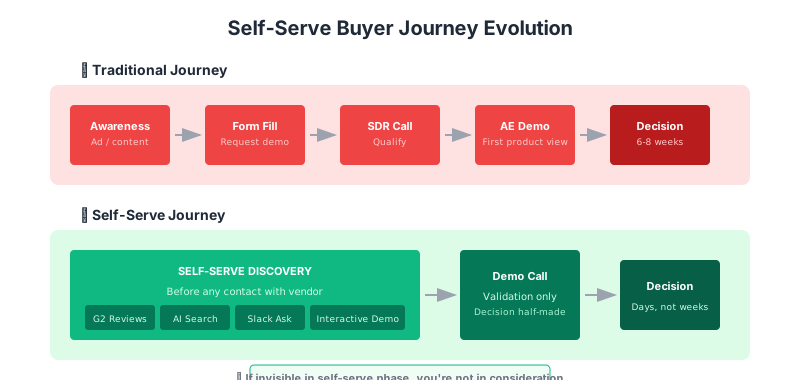
Second, her sales team started reporting that prospects were showing up to discovery calls already knowing things they shouldn't have known—competitive pricing, technical limitations, integration details that lived in documentation Sarah's team hadn't even promoted.
Third, and most unsettling, two enterprise deals closed in under three weeks. That had never happened before. The typical sales cycle for Sarah's product was eleven weeks.
Sarah's first instinct was that something was broken in the analytics. Maybe a tracking pixel had died. Maybe the CRM had hiccupped. But the data was clean.
What had actually changed was something far more interesting: her buyers had started using AI agents to do the research, the comparison shopping, and the vendor pre-qualification that used to take human buying committees weeks of meetings, spreadsheets, and hallway conversations to accomplish.
What the Agents Were Doing
The agents weren't doing anything magical.
They were reading her product documentation—all of it, including the stuff buried three clicks deep that no human prospect ever found.
They were pulling her pricing from G2 and Gartner Peer Insights and running it against competitors.
They were synthesizing analyst reports and customer reviews into concise briefs for their human principals.
They were, in effect, doing the job of a procurement analyst, a technical evaluator, and a competitive intelligence researcher all at once—and they were doing it in hours instead of weeks.
Sarah's content hadn't changed. Her positioning hadn't changed. Her product hadn't changed. But her buyer had fundamentally changed—or rather, her buyer had hired an intermediary that didn't care about brand affinity, didn't respond to emotional storytelling, and couldn't be schmoozed over a steak dinner.
The Structural Transformation
If you're a product marketer—whether you carry the title of PMM, Director of Product Marketing, or VP of Go-to-Market—you already feel the ground shifting.
You've probably been told that AI will "supercharge your workflow." You've been handed a ChatGPT license and told to figure it out.
Maybe your company has an AI task force that meets biweekly and produces PowerPoint decks about "the art of the possible."
None of that captures what's actually happening.
The real story is that the economics, the workflows, and the buyer dynamics that have defined product marketing for the last twenty years are all changing at once.
The Three Eras of Data-Driven Marketing
To understand where we're going, it helps to understand how we got here.
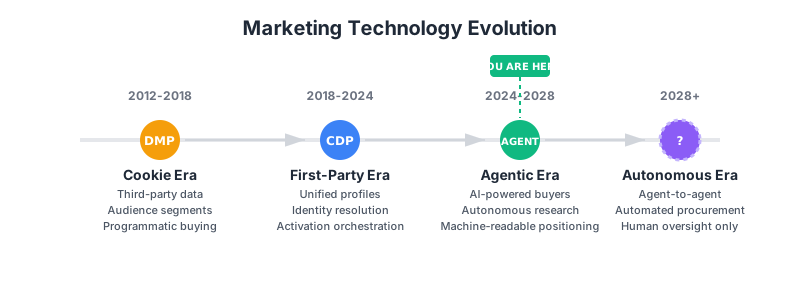
Era One: The DMP and the Age of Audiences
The data management platform era was, in hindsight, wonderfully simple. You had third-party cookies. You had audience segments. You had a machine that could ingest behavioral data from across the web.
The pitch was seductive: know your audience. Not your customer, not your user—your audience.
The DMP era had a character worth remembering. It was anonymous. The audiences in your DMP were probabilistic—they were cookie pools, not people.
Era Two: The CDP and the Age of Customers
The customer data platform era was the correction to everything the DMP got wrong.
Where the DMP was anonymous, the CDP was identity-based. Where the DMP lived in the ad stack, the CDP connected to CRM and email and commerce and service.
The shift mattered enormously for product marketers. The PMM's job expanded to include lifecycle marketing, personalization strategy, customer journey mapping.
Era Three: The AMP and the Age of Agents
Which brings us to now.
A DMP knew your audience. A CDP knew your customer. An AMP—an agentic management platform—knows your business.
When I say agentic, I mean something specific: software systems that can perceive their environment, make decisions, and take actions without waiting for a human to tell them what to do at each step.
Not chatbots. Not copilots that suggest the next sentence in your email.
Agents that monitor your competitive landscape while you sleep. Agents that adjust your pricing recommendations based on real-time market signals. Agents that generate and test messaging variants based on what's resonating with different buyer segments.
The Visibility Gap
While the PMM discipline transforms internally, buyer behavior transforms externally. The two forces converge in what I call the visibility gap.
SEO Is Not GEO
Search engine optimization has been table stakes for PMMs for twenty years. You know the playbook: keyword research, on-page optimization, backlink building, technical SEO, content clusters.
It works. It still works. Google isn't going anywhere.
But a new discipline is emerging alongside it: Generative Engine Optimization, or GEO.
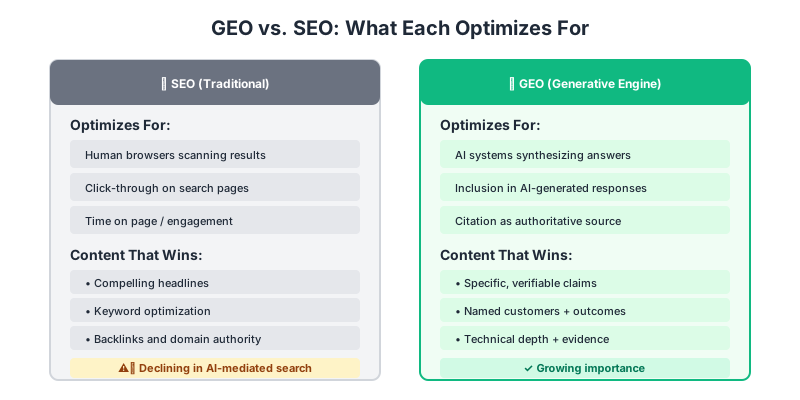
The signals that make you rank in Google—backlinks, domain authority, keyword density—are not the same signals that make you cited in an AI response. AI models weight specificity, verifiability, and semantic coherence.
The Citation Economy
The emerging competition is not for clicks. It's for citations.
Content that gets cited tends to be:
- Specific. Numbers, dates, names, benchmarks. "Our platform processes 50,000 transactions per second" beats "Our platform is blazingly fast."
- Structured. Comparison tables, feature matrices, technical specifications.
- Verifiable. Claims that can be cross-referenced against other sources.
- Current. Content with clear publication dates and regular updates.
If your competitive positioning lives in a beautifully designed PDF that no AI can parse, you're invisible.
If your technical documentation is comprehensive but buried behind a login, you're invisible.
The visibility gap is real, and most B2B companies haven't begun to address it.
The New PMM Operating Model
This reconfiguration suggests a new operating model for product marketing:
- Pre-agent content — the documentation, specifications, and structured information that gets scraped, indexed, and cited by AI agents. This is table stakes.
- Agent-aware positioning — competitive claims designed to surface favorably in AI comparisons. This is the new battleground.
- Post-agent enablement — the human-to-human materials for when the buyer emerges from their AI research ready to engage. This is where relationships close deals.
Most PMM teams are still operating on the old model: top-of-funnel content for awareness, mid-funnel content for consideration, bottom-of-funnel content for decision.
That model isn't wrong—but it's incomplete. It needs an agent layer inserted before the human ever shows up.