The traditional product launch takes three to four months of coordinated effort.
Messaging development. Sales training. Content creation. Analyst briefings. Press outreach. Customer communications. Internal alignment across a dozen stakeholders.
Each phase has dependencies. Each dependency has delays. The timeline stretches.
AI changes the math on almost every phase.
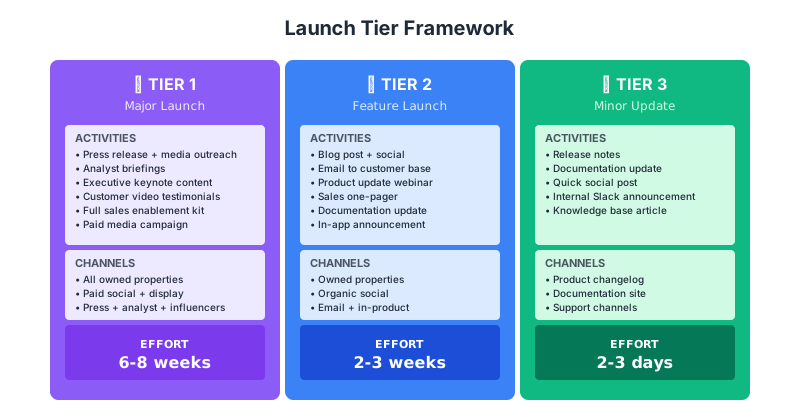
What Actually Compresses
Not everything about launches can be accelerated. Understanding what compresses—and what doesn't—is the key to faster launches that don't implode.
Compressible: Content Production
Once you have solid positioning and messaging, AI can produce launch content at 5-10x the speed of traditional approaches.
- First drafts of blog posts, social copy, email sequences
- Sales deck variations for different audiences
- FAQ documents and objection handlers
- Internal communications and training materials
The bottleneck shifts from "can we produce enough content?" to "can we review and approve fast enough?"
Compressible: Research and Synthesis
Competitive analysis, market sizing, customer insights—the research that informs positioning can be dramatically accelerated.
What used to take two weeks of analyst time takes two days with AI doing the heavy lifting and humans doing the interpretation.
Not Compressible: Strategic Decisions
Positioning choices. Pricing decisions. Go/no-go calls. Executive alignment.
These require human judgment, organizational politics, and often multiple rounds of discussion. AI can inform these decisions with better data, faster. But the decisions themselves take human time.
Not Compressible: External Dependencies
Analyst briefing schedules. Press embargo timelines. Partner coordination. Customer reference availability.
Other organizations don't move faster just because you have AI. External dependencies remain the pacing constraint for many launches.
The launches that compress well are internally-focused, content-heavy, and don't require extensive external coordination. The launches that don't compress are those dependent on external parties, regulatory approvals, or complex organizational alignment.
The Compressed Launch Playbook
Week 1: Strategy Sprint
Traditionally spread across 4-6 weeks, compressed to 5 days:
- Day 1-2: AI-assisted competitive and market analysis
- Day 3: Positioning workshop with pre-synthesized inputs
- Day 4: Messaging development with AI drafting
- Day 5: Stakeholder review and approval
Front-load the human decisions. AI handles research and drafting in parallel with stakeholder scheduling. By the time humans are in the room, all the inputs are ready.
Week 2: Content Blitz
All launch content produced in parallel:
- AI generates first drafts of all content types simultaneously
- Human review and revision in priority order
- Design and production running parallel to content finalization
- Sales enablement materials produced alongside external content
Week 3: Enablement and Testing
- Sales training with AI-generated scenarios and objection practice
- Internal launch readiness review
- Final content QA and approval
- Technical readiness confirmation
Week 4: Launch Execution
- Coordinated external communications
- Analyst and press outreach
- Customer communications
- Monitoring and rapid response
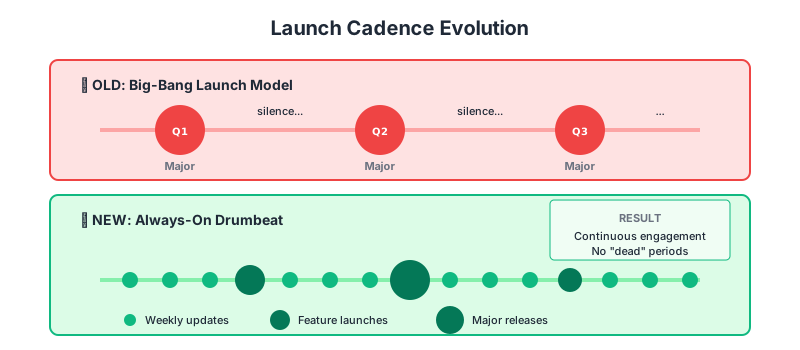
When Speed Hurts
Faster isn't always better. Speed kills launches when:
Positioning isn't solid. Rushing through positioning to save time means all downstream content is built on a shaky foundation. The fix costs more than the time saved.
Stakeholders aren't aligned. Compressed timelines with misaligned executives lead to last-minute reversals. The chaos costs more than a longer timeline with proper alignment.
Quality visibly suffers. AI-generated content that reads as generic or off-brand damages the launch more than a delay would.
Sales isn't ready. Launching before sales can effectively sell means wasted demand. Better to delay than to generate interest you can't convert.
Compress execution, not decisions. Use AI to do things faster, not to skip the thinking that determines whether those things are the right things to do.