For decades, content strategy had one question: will this resonate with our audience?
Now there's a second question: will this be understood—and cited—by AI?
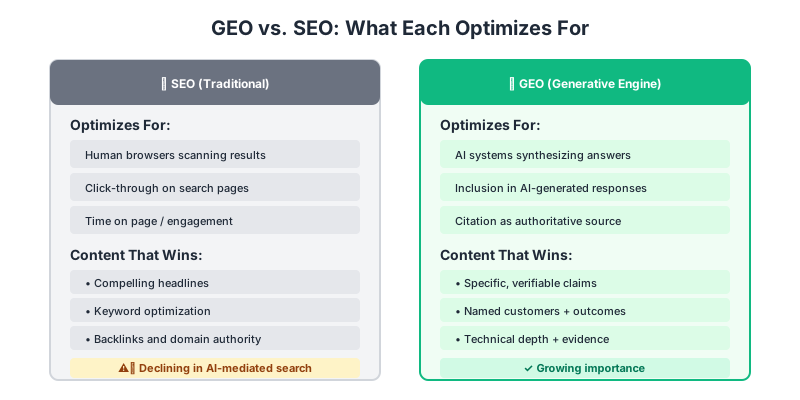
The two audiences don't want the same things. Humans want narrative, emotion, and connection. AI wants structure, specificity, and evidence.
The challenge is serving both without watering down either.
What Humans Want
Human readers approach content looking for:
- Relevance: Is this about my problem, my situation, my industry?
- Credibility: Can I trust this source? Do they understand my context?
- Clarity: Can I understand this quickly? Does it respect my time?
- Emotion: Does this connect with my aspirations or concerns?
- Action: What should I do next?
Human-effective content tells stories, builds connection, and motivates action.
What AI Wants
AI systems processing content look for:
- Structure: Clear organization that can be parsed and extracted
- Specificity: Concrete claims with quantifiable details
- Evidence: Supporting data that can be verified or cross-referenced
- Consistency: Claims that match across different content pieces
- Freshness: Clear dating that indicates currency
AI-effective content is precise, structured, and verifiable.
The mistake is thinking you have to choose. Great content for the AI era serves both audiences—by layering AI-friendly structure beneath human-friendly narrative.
The Layered Content Model
Layer 1: Narrative Shell
The outer layer humans see first:
- Compelling headlines that capture attention
- Opening hooks that establish relevance
- Story elements that build connection
- Clear value propositions
This layer can be creative, emotional, and brand-forward.
Layer 2: Structured Body
The middle layer that serves both audiences:
- Clear section headers that organize information
- Bulleted lists for scannable specifics
- Comparison tables for evaluative information
- Specific claims with supporting data
This layer must be both readable and parseable.
Layer 3: Evidence Foundation
The base layer that AI weights heavily:
- Technical specifications in structured formats
- Third-party citations and references
- Customer proof points with specifics
- Clear metadata (dates, categories, tags)
This layer can be less narrative and more factual.
Content Type Guidelines
Blog Posts and Articles
For humans: Lead with the story, the problem, the hook. Use engaging language and real examples.
For AI: Include structured takeaways. Add a summary section with key points. Cite specific data and sources.
Product Pages
For humans: Clear value proposition. Benefits-focused messaging. Visual hierarchy that guides attention.
For AI: Structured feature lists. Specific capabilities with metrics. Comparison data that can be extracted.
Documentation
For humans: Clear organization. Easy navigation. Practical examples.
For AI: Structured metadata. Consistent formatting. Complete technical specifications.
After creating content, ask: "Would a human find this engaging?" and "Would an AI find this informative?" If the answer to either is no, revise.
The Measurement Challenge
Traditional content metrics measure human engagement:
- Page views, time on page, scroll depth
- Conversion rates, lead generation
- Social shares, backlinks
AI effectiveness requires different measurement:
- How often are you cited in AI responses?
- What claims do AI systems extract and repeat?
- Where do AI evaluations misunderstand your positioning?
Build both measurement approaches into your content evaluation.