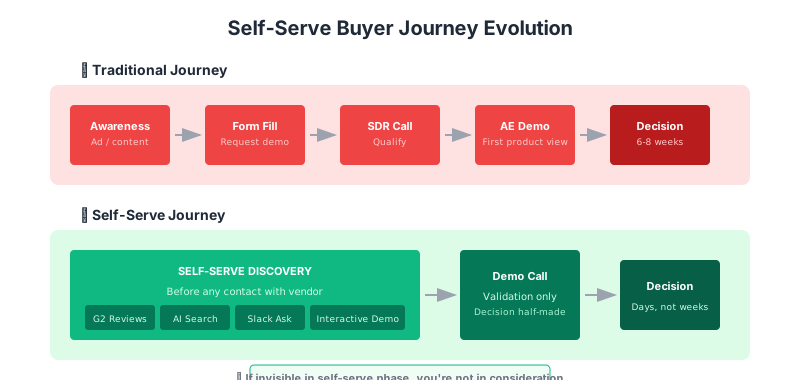
The traditional demand generation funnel assumed a specific buyer behavior:
Problem awareness leads to search. Search leads to content consumption. Content leads to form fills. Form fills lead to qualification. Qualification leads to sales engagement.
Each stage had its metrics. Each metric had its optimization playbook.
AI agents are breaking this model at the search stage—and the ripple effects change everything downstream.
What Changes
The Search Phase Compresses
A buyer who used to spend three weeks in "research mode" now spends three hours.
They don't visit ten vendor websites. They ask an AI to compare vendors and summarize the landscape.
Your awareness-stage content—the blog posts, the ebooks, the thought leadership—may never be directly consumed. It might be synthesized into an AI response that the buyer reads instead.
The Discovery Path Changes
Traditional funnel: organic search → your blog → your product page → form fill
AI-mediated path: buyer asks AI → AI synthesizes including your content → buyer goes direct to evaluation
You might get the conversion, but you lose the journey that traditional analytics tracked.
The Qualification Signal Disappears
Gated content worked because it created exchange: information for contact details.
When AI can synthesize your gated content from other sources, or when buyers use AI to evaluate without downloading your ebook, the qualification signal vanishes.
The demand gen team that measures success by MQLs from form fills is measuring a shrinking signal. The buyers are still there—they're just not leaving the footprints they used to.
What Works Now
Optimize for AI Citation
If AI agents are summarizing your market for buyers, be the source they cite.
- Create content with specific, citable claims
- Structure information for AI extraction
- Provide comparison data that AI can reference
- Make technical documentation comprehensive and accessible
Capture Intent Differently
Form fills aren't the only intent signal. Look for:
- Product usage signals: Free tier engagement, feature exploration
- Content depth signals: Technical documentation access, pricing page visits
- Community signals: Questions in forums, Slack community engagement
- Direct signals: Chat conversations, demo requests that skip the funnel
Accelerate to Conversation
If the research phase is compressing, meet buyers where they exit research: ready to talk.
- Make sales access easy and visible
- Offer instant scheduling, not "request a demo and wait"
- Provide chat that connects to humans quickly
- Enable self-service evaluation where possible
From generating demand through content consumption to capturing demand when buyers emerge from AI-assisted research ready to engage.
Metrics That Still Matter
Not all traditional metrics are obsolete:
- Pipeline created: Ultimately, demand gen exists to create pipeline
- Sales velocity: If AI is compressing research, deals should move faster
- Win rates: Better-informed buyers might mean better-fit deals
- Customer acquisition cost: If the funnel is leaky, is cost per acquired customer still efficient?
New Metrics to Build
- AI visibility: How prominently do you appear in AI responses for category queries?
- Citation frequency: How often is your content referenced in AI summaries?
- Direct engagement rate: What percentage of buyers skip the funnel and engage directly?
- Time to conversation: How quickly do interested prospects reach a human?
The demand gen playbook is being rewritten. The winners will be those who recognize that optimizing for human search behavior and AI synthesis behavior require different—but complementary—strategies.