If AI can generate content, analyze data, monitor competitors, and accelerate research—what's left for the human PMM?
Everything that matters.
The activities that can be automated are, by definition, the activities that were never the highest-value parts of the job. They were necessary, but they weren't what made great PMMs great.
What made great PMMs great—and what will define great PMMs in the AI era—are four irreducibly human capabilities.
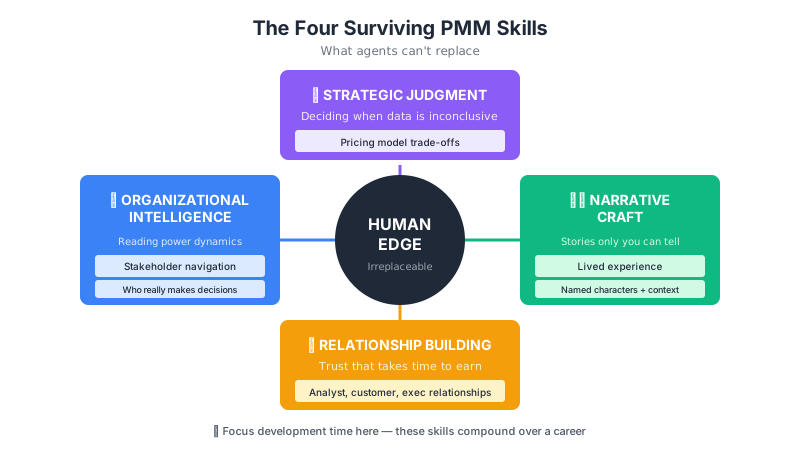
1. Strategic Judgment
AI can analyze options. It can't choose among them.
Strategic judgment is the ability to make decisions under uncertainty—to choose this positioning over that one, to prioritize this market over that one, to invest in this bet rather than that bet.
What It Looks Like
- Looking at competitive analysis and deciding what it means for your strategy
- Evaluating market opportunities and choosing where to focus
- Assessing messaging options and selecting the one that fits your strategy
- Knowing when data supports a decision and when you need to trust intuition
How to Build It
Strategic judgment develops through making decisions and learning from outcomes.
Keep a decision journal: what did you decide, why, what happened. Review quarterly. Calibrate your judgment against reality.
Seek projects that require choices, not just execution. Volunteer for the decisions others avoid.
AI gives you better inputs for decisions. It doesn't make you better at deciding. That skill develops through practice, reflection, and accumulated experience.
2. Organizational Intelligence
AI can analyze org charts. It can't navigate them.
Organizational intelligence is the ability to get things done through people—to build alignment, manage stakeholders, and move ideas through complex human systems.
What It Looks Like
- Reading a room and knowing whose objection is real versus performative
- Understanding power dynamics that aren't visible in reporting structures
- Building coalitions across functions
- Knowing when to push, when to wait, and when to route around
How to Build It
Pay attention to how decisions actually get made—not how they're supposed to get made.
Build relationships across functions before you need them. Understand what other teams care about and how your work connects to their goals.
Study the people who are effective at driving change in your organization. What do they do differently?
As AI handles more execution, the PMM's value shifts toward alignment and influence. The best strategy means nothing if you can't get the organization to execute it.
3. Narrative Craft
AI can generate stories. It can't tell your story.
Narrative craft is the ability to shape how people understand your product, your market, and your company—to create meaning through story.
What It Looks Like
- Finding the angle that makes complex products feel simple
- Turning features into stories that resonate emotionally
- Developing a distinctive voice that cuts through noise
- Creating narratives that stick—that people repeat and share
How to Build It
Study great storytelling. Read widely. Pay attention to what captures your attention and why.
Write and publish. Develop your voice through practice. Accept that early work will be mediocre.
Seek feedback on your narratives. Do they land? Do people remember them? Do they get repeated?
AI floods the world with competent content. Human narrative craft becomes more valuable by contrast—the signal in the noise.
4. Systems Thinking
AI can optimize components. It can't design systems.
Systems thinking is the ability to see how pieces fit together—to design workflows, processes, and go-to-market motions that work as integrated wholes.
What It Looks Like
- Designing launch processes that coordinate across functions
- Building competitive intelligence systems, not just gathering competitive intelligence
- Creating enablement approaches that actually change behavior
- Architecting content strategies that compound over time
How to Build It
When you build something, think about how it will work over time—not just whether it works today.
Look for second-order effects. If we do X, what will happen next? And then what?
Study systems that work well. What makes them effective? What would break them?
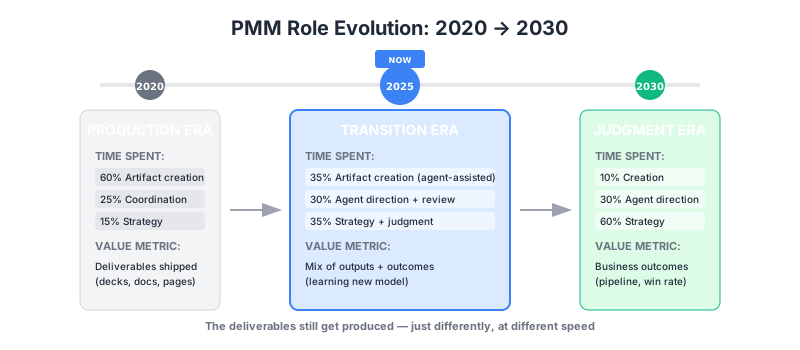
The 10x PMM Revisited
The "10x PMM" isn't someone who works ten times harder or even ten times faster.
It's someone who operates at a fundamentally different level because they've offloaded the mechanical work to AI and focused their energy on the four capabilities that only humans can develop.
Strategic judgment that makes the right calls.
Organizational intelligence that gets things done.
Narrative craft that creates meaning.
Systems thinking that builds for the long term.
Build agent fluency now—but don't stop there. Invest deliberately in the four surviving skills. They're not innate. They're developed through practice. The PMMs who start now will have a compounding advantage that grows with every year of the AI era.
The landscape will keep evolving. The tools will get better. New capabilities will emerge.
But the fundamentals—strategic judgment, organizational intelligence, narrative craft, systems thinking—will remain the foundation of great product marketing.
Build on that foundation, and you'll be ready for whatever comes next.