Every vendor promises AI will transform your work. Most of those promises are inflated.
After a year of testing tools across the PMM stack, here's what actually delivers value—and what's better to skip.
The Foundation: Large Language Models
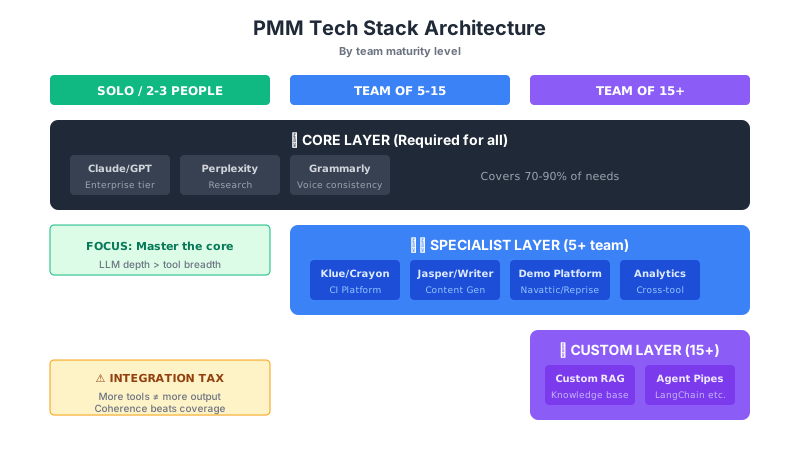
Before specialized tools, get good at the foundation. A PMM fluent with Claude or GPT-4 can accomplish most AI-assisted tasks without additional software.
What Works
- First-draft generation: Messaging, content, emails, sales materials
- Research synthesis: Summarizing competitive info, market data, analyst reports
- Analysis: Reviewing win/loss data, customer feedback, usage patterns
- Brainstorming: Generating options for positioning, naming, campaign concepts
Where It Falls Short
- Real-time data: LLMs don't know what happened yesterday
- Proprietary information: They can't access your CRM, your internal docs, your customer data
- Workflow integration: Copy-pasting between tools creates friction
Most PMMs can get 80% of AI value from skilled use of foundation models, without buying additional tools. Master the basics before adding complexity.
Competitive Intelligence Tools
What Works
Klue, Crayon, Kompyte: Automated monitoring of competitor websites, news, job postings, reviews. Good at surfacing changes you'd otherwise miss.
Best for: Teams tracking many competitors who need automated alerting and structured battlecard management.
What's Overhyped
Claims of "AI-powered competitive strategy." The tools are good at data collection and surface-level analysis. Strategic interpretation still requires human judgment.
Alternative Approach
For smaller teams: Google Alerts + Visualping for monitoring, foundation LLMs for analysis, Notion for storage. Lower cost, more manual, but functional.
Content Creation Tools
What Works
Foundation LLMs: Still the best for quality content generation when you provide good input.
Jasper, Copy.ai, Writer: Useful for high-volume content with brand voice consistency. Better for marketing content than thought leadership.
What's Overhyped
"AI that writes like a human." It doesn't. It writes like competent-but-generic AI. For differentiated content, you still need human craft.
The best content tools are accelerators, not replacements. They get you to a first draft faster. The editing that makes it great is still human work.
Sales Intelligence Tools
What Works
Gong, Chorus, Clari: Call recording and analysis. Excellent for understanding what sales is actually saying, what objections arise, how competitors are positioned in conversations.
Best for: Win/loss intelligence at scale, message testing, objection pattern identification.
What's Overhyped
"AI-powered sales coaching." The analysis is good. The coaching recommendations are generic. Human sales leaders still need to interpret and apply.
Market Research Tools
What Works
Perplexity, Claude with web access: Fast synthesis of public information. Good for quick competitive scans and market landscape summaries.
Wynter, UserTesting: Combining AI analysis with real human feedback. AI accelerates pattern finding; humans provide authentic responses.
What's Overhyped
"AI-generated market research." AI can synthesize existing information. It can't conduct primary research or surface genuinely new insights about customer behavior.
Building Your Stack
Start Here
- Foundation model subscription: Claude Pro or ChatGPT Plus. Master it before adding tools.
- Note-taking with AI: Notion AI or similar for organizing research and generating summaries.
- Basic monitoring: Google Alerts for competitor tracking. Free and functional.
Add When Needed
- CI platform: When you're tracking 5+ competitors and need automated alerts and structured storage.
- Call intelligence: When you have enough call volume that manual review is impossible.
- Content tools: When volume demands exceed what foundation models can deliver.
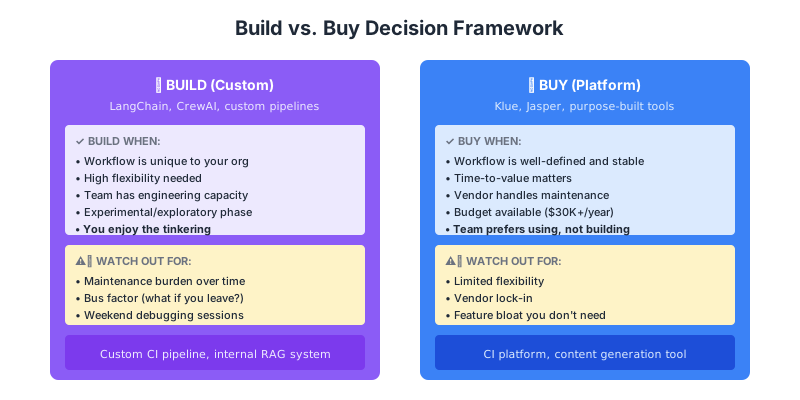
Add tools to solve specific problems you've already encountered—not problems vendors tell you that you have. Every tool adds complexity. Make sure the value exceeds the cost.