If you've been through Pragmatic Institute training—and there's a decent chance you have, since they've certified over 250,000 professionals—you know the Framework.
Thirty-seven boxes arranged in seven categories: Market, Focus, Business, Planning, Programs, Enablement, and Support. Each box represents an activity that a product team needs to execute well to bring a product to market successfully.
I've stared at that framework for the past year, trying to answer a question that I couldn't find anyone else asking rigorously:
What happens to each of those thirty-seven boxes when AI agents become part of the team?
Not in the abstract, feel-good, "AI will augment human creativity" sense. Concretely. Activity by activity.
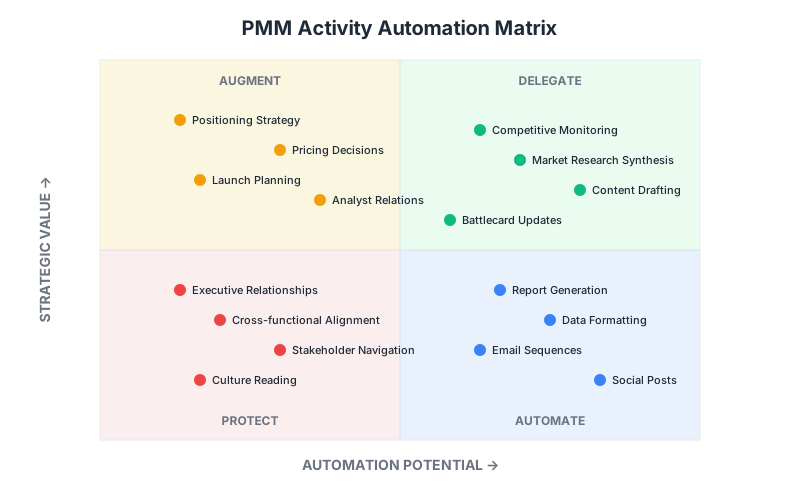
The Scoring Methodology
I scored each of the thirty-seven Pragmatic activities across three dimensions:
Automation potential: On a scale of 1 to 5, how much of this activity can an AI agent perform today, with commercially available tools?
A score of 1 means the activity is almost entirely human. A score of 5 means an agent can do it end-to-end with minimal human oversight.
Augmentation value: On a scale of 1 to 5, how much better does a human-plus-agent team perform than a human alone?
Some activities can't be fully automated but become dramatically more effective when an agent handles the research, synthesis, or first-draft generation.
Elevation opportunity: On a scale of 1 to 5, does this activity become more strategically important when the routine work around it is automated?
This is the dimension most people miss. When you free up the hours that used to go into gathering competitive data, the act of interpreting that data and making strategic decisions based on it doesn't just stay the same—it gets elevated.
Cluster One: Automated
These are activities where automation potential scored 4 or 5—meaning AI agents can perform the majority of the work today, with human oversight reduced to quality checks and strategic direction.
Market Sizing · Content Production · Event Support Operations · Sales Tools Production · Routine Marketing Plan Elements · Competitive Data Gathering
Market Sizing
The traditional approach: a PMM spends two to three weeks pulling data from Gartner, IDC, Statista, company filings, and industry reports. They build a bottom-up model in Excel. They triangulate against a top-down estimate.
An agent with access to the right data sources can do this in an afternoon.
Not approximately. Actually well. The human's job shifts from doing the analysis to validating it and challenging the assumptions.
Content Production
Once you have a core messaging framework and a strong point of view, the mechanical act of turning that into blog posts, social copy, email sequences, slide decks, and sales one-pagers is straightforward generation work.
The first-draft quality is good enough that the human's job becomes editing and elevation rather than creation from scratch.
That's a 70% time savings on the production side, conservatively.
Here's the uncomfortable truth about Cluster One: these are the activities that many PMMs spend the majority of their time on. If you're a PMM whose primary value is producing artifacts—the battlecard, the one-pager, the launch email sequence—the automation wave is not your friend.
Cluster Two: Augmented
These activities scored high on augmentation value (4 or 5) but moderate on automation potential (2 or 3).
The human remains essential, but the human-agent team is so much better than the human alone that operating without agents becomes a competitive disadvantage.
Positioning · Win/Loss Analysis · Buyer Personas · Buying Process Mapping · Use Case Development · Pricing Strategy · Go-to-Market Planning
Positioning
No agent is going to write your positioning from scratch.
Not because the technology can't generate positioning statements—but because positioning is fundamentally a strategic choice about what you want to be known for, who you're willing to lose, and how you want to show up relative to alternatives.
But an agent can synthesize the inputs that inform those judgment calls—win/loss data, competitive positioning shifts, analyst commentary, customer verbatims—at a speed and comprehensiveness that no human can match.
Win/Loss Analysis
The traditional process: interview the sales rep, maybe interview the customer, write up the findings, identify patterns.
It's time-intensive and limited by sample size.
An agent-augmented PMM can process hundreds of deal records, pull themes from call transcripts, cross-reference against CRM data, and surface patterns that would take a human months to identify.
The human still needs to interpret those patterns, but the input quality is transformatively better.
Cluster Three: Elevated
These activities scored high on elevation opportunity (4 or 5) and low on automation potential (1 or 2).
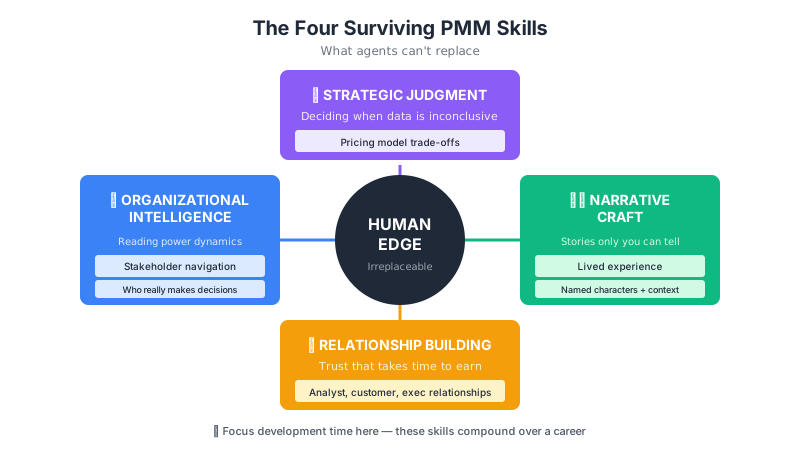
These are the activities that become more important, more central, and more career-defining in the agentic era precisely because they are the ones that machines can't do.
Stakeholder Management · Thought Leadership · Customer Empathy · Distinctive Competence · Strategic Channel Management · Innovation Games
Stakeholder Management
Every PMM knows that the hardest part of the job isn't writing the positioning document—it's getting twelve people to agree on it.
It's navigating the VP of Sales who wants feature-led messaging, the CPO who wants vision-led messaging, the CFO who wants ROI-led messaging, and the CEO who wants all three on a single slide.
No agent is going to sit in that room and read the body language and know that the real objection isn't what's being said.
That's organizational intelligence. It's learned, not computed.
Thought Leadership
Real thought leadership, not the commodity-content kind.
AI makes it trivially easy to produce content that looks like thought leadership but contains no actual thinking. The market is about to be flooded with competent, bland, algorithmically generated "insights."
The PMM who can cut through that noise with a genuine perspective—earned through experience, grounded in specific stories, delivered with a voice that is recognizably human—is going to be more valuable than ever.
Customer Empathy
An agent can analyze ten thousand support tickets and tell you that 23% mention onboarding friction.
A human can sit across from a customer, watch their face when they describe trying to get their team to adopt a new tool, and understand that the real problem isn't the onboarding UX—it's that the customer doesn't have executive sponsorship and they're trying to drive adoption bottom-up in a top-down culture.
That's a completely different product marketing challenge, and no amount of ticket analysis will surface it.
The 10x Map: Reallocating Your Time
Here's what the three clusters mean in practical terms for how you spend your time.
If you're a PMM who currently spends 60% of your week on Cluster One activities—producing artifacts, gathering data, updating decks, coordinating logistics—you have a choice.
You can keep doing those things the way you've always done them, in which case you're going to find yourself increasingly redundant as agents get better.
Or you can invest the next six months in building agent-powered workflows for those activities, reclaim those hours, and reinvest them in Cluster Two and Cluster Three work.
The math isn't complicated. A PMM who automates 20 hours a week of Cluster One work and redirects that time into deeper competitive analysis, more thoughtful positioning, better stakeholder management, and genuine thought leadership is going to outperform a PMM who's still manually updating battlecards. Not by 20%. By a factor that justifies the title "10x."
What "10x" Actually Means
That's what "10x yourself" means.
Not working ten times harder or ten times faster.
Operating at a fundamentally different level of strategic impact because you've offloaded the mechanical work to machines that are built for it, and you're finally free to do the work that only a human can do.
The judgment. The navigation. The stories. The voice.
Product marketing has always suffered from being spread too thin. The Pragmatic Framework has thirty-seven activities because the job really does encompass all of that. No single person can do all thirty-seven well. The agentic era doesn't shrink the list—it makes it possible, for the first time, for an individual PMM to meaningfully cover the full scope while going deep on the activities that matter most.
Self-Assessment: Where Do You Spend Your Time?
Before moving forward, take fifteen minutes to assess your current state:
Time Allocation
- In a typical week, what percentage of your time goes to Cluster One activities (artifact production, data gathering, coordination)?
- What percentage goes to Cluster Two (strategic analysis with research support)?
- What percentage goes to Cluster Three (stakeholder navigation, thought leadership, customer insight)?
Automation Opportunity
- Which Cluster One activity consumes the most of your time?
- What would it take to automate or significantly accelerate that activity?
- What would you do with the reclaimed hours?
Write your answers. This exercise reveals both your vulnerability and your leverage opportunity.