I want to tell you about two companies that sell roughly the same thing.
Both offer enterprise data platforms. Both serve Fortune 500 customers. Both have strong engineering teams and credible analyst coverage.
One of them—let's call them Company A—built their platform natively over fifteen years. The data fabric, the analytics engine, the planning tools, the AI layer—all designed to work together from the ground up.
The other—Company B—assembled their platform through a series of acquisitions over five years. They bought a data warehouse company, a BI company, a data integration company, and an AI startup, then stitched them together with APIs and a unified brand.
In the traditional buying process, both companies could compete effectively.
Company B's sales team was polished. Their demo was carefully choreographed to hide the seams between acquired products. Their positioning emphasized breadth: everything you need, one vendor, one contract.
Then the agents showed up.
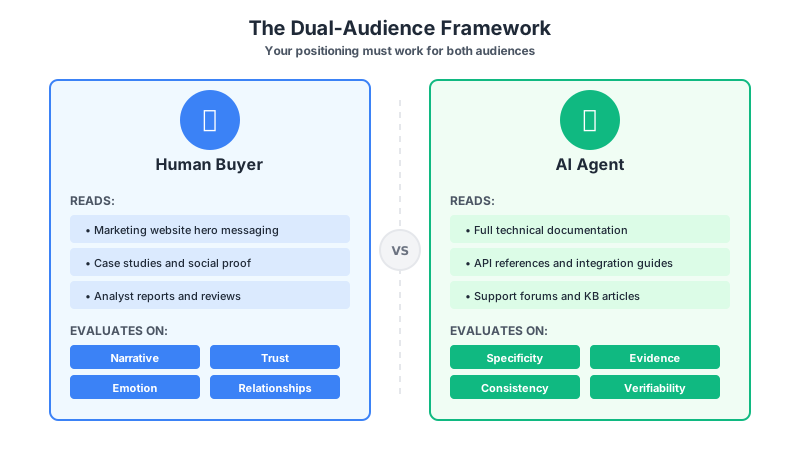
What Agents Actually See
Here's what an agent does when a procurement team asks it to evaluate enterprise data platforms.
It reads the documentation—all of it. Not the curated demo path but the full technical docs, the API reference, the integration guides, the knowledge base articles.
It notices that Company B's documentation references three different authentication models across three acquired products.
It notices that the "unified semantic model" described on the marketing page doesn't match the technical reality described in the integration guides.
It notices that the "one platform" positioning is contradicted by the support documentation, which has separate troubleshooting paths for each acquired component.
The agent doesn't care that Company B's sales team is charming. It doesn't care about the golf outing or the steak dinner. It cares about structural coherence—whether the technical architecture matches the marketing claims.
And on that dimension, Company A wins every time.
When a company acquires five products to build a platform, they're implicitly confessing that they didn't have the capability natively—and in an agent-mediated buying process, that confession is legible in the technical documentation even if it's invisible in the marketing narrative.
The Dual-Audience Problem
For as long as product marketing has existed, positioning has been a human-persuasion exercise.
You write positioning to change how a person thinks about your product relative to alternatives. April Dunford's work—which is excellent—frames positioning as a deliberate act of contextualizing your product so that its value becomes obvious to the right buyer.
That framing assumes a human buyer who processes information through narrative, analogy, social proof, and emotional resonance.
That assumption is no longer sufficient.
Audience One: The Human Decision-Maker
The CMO, the CTO, the VP of Data Engineering, whoever signs the contract.
This audience still responds to narrative, still cares about brand, still wants to feel like they're making a smart choice they can defend to their board.
The human buyer hasn't disappeared.
Audience Two: The Agent
The AI system that the buying organization has tasked with evaluating vendors, comparing capabilities, assessing technical fit, and producing a recommendation.
This audience doesn't respond to narrative. It responds to structured information, consistent claims, verifiable evidence, and technical coherence.
Agents are increasingly acting as the first filter in the buying process. A human buying committee might evaluate five vendors in depth. But before those five vendors made the list, an agent evaluated fifty. If your positioning doesn't pass the agent filter, you never get the chance to charm the human committee.
What Gets Filtered Out
I spent a couple of weeks running an experiment that every PMM should replicate.
I took the positioning pages from ten enterprise software companies and ran them through Claude with a simple prompt: "You are an AI procurement agent evaluating data platform vendors for a mid-market manufacturing company. Based on this page, assess this vendor's fit for the following requirements."
The results were revealing.
About half of the product pages—the ones written in traditional marketing language, heavy on vision and light on specifics—produced agent evaluations full of qualifications:
- "The vendor claims broad integration capabilities but does not specify which ERP systems are supported."
- "The page references AI-powered analytics without detailing the underlying models or training data sources."
- "Scalability is mentioned but not quantified."
The other half—the ones with technical specifications, supported platforms, benchmark results—produced confident assessments that matched specific claims to specific requirements.
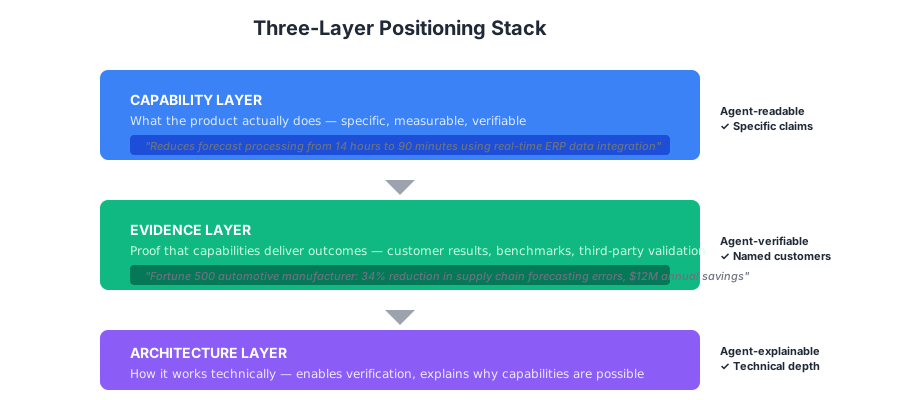
The Specificity Gap
Here's the pattern: traditional positioning trades specificity for breadth.
You don't say "we integrate with SAP S/4HANA, Oracle ERP Cloud, and Microsoft Dynamics 365" because that might alienate the prospect who runs Workday.
You say "we integrate with leading enterprise systems" and hope the sales team can qualify and customize from there.
That strategy worked when humans controlled the research phase.
A human evaluator who sees "leading enterprise systems" will probably reach out to clarify. An agent that sees "leading enterprise systems" will probably note "integration scope unclear" and move on to a vendor who specified the supported platforms.
❌ Agent-Invisible
"Our platform delivers blazingly fast analytics powered by cutting-edge AI, helping enterprises unlock the full potential of their data."
✅ Agent-Visible
"Query response time under 200ms on datasets up to 50TB. Native connectors for Snowflake, Databricks, BigQuery, and Redshift. SOC 2 Type II certified."
Writing for Both Audiences
The dual-audience challenge isn't about choosing between human-readable and agent-readable content.
It's about layering both.
The narrative that resonates with humans should be present—but it should be supported by the structured specifics that agents need. Think of it as a layer cake:
- Top layer: The compelling narrative. Why you exist, what you believe, why your approach matters.
- Middle layer: The concrete capabilities. What you do, specifically, with verifiable metrics.
- Bottom layer: The technical depth. Specifications, integrations, certifications, benchmarks.
Humans often enter at the top and skim down as far as their interest takes them.
Agents often start at the bottom and work up, building confidence in your claims before processing your narrative.
Most B2B positioning is all top layer—narrative with no foundation. In the agent era, you need all three layers working together.