This article is the practical companion to "From Quarterly Battlecards to Always-On Competitive Intelligence."
Where that article explained the why, this one explains the how—with specific tools, workflows, and implementation patterns you can use to build your own competitive monitoring system.
The Minimum Viable Monitoring Stack
You don't need enterprise CI platforms to get started. Here's a minimum viable stack that a solo PMM can implement in a weekend:
Signal Collection
- Website monitoring: Visualping or ChangeTower for automated screenshots of competitor pricing and feature pages
- News alerts: Google Alerts for competitor names, product names, and key executives
- Social monitoring: Follow competitor company pages and executives on LinkedIn; set up saved searches
- Review tracking: G2 and Gartner Peer Insights email alerts for new reviews
- Job board monitoring: LinkedIn job alerts for competitor hiring in key roles
Signal Processing
- Aggregation: Zapier or Make to route all alerts to a single channel (Slack, email folder, Notion database)
- AI triage: Claude or GPT-4 to assess signal significance (can be automated via API or done manually in batches)
- Storage: Notion or Airtable database for structured competitive intel
Output and Distribution
- Living battlecard: Notion page or Google Doc with structured sections that can be updated incrementally
- Alerts: Slack channel for real-time competitive updates
- Weekly digest: AI-generated summary of the week's competitive movements
The AI Agent Workflow
The power comes from chaining these components with AI agents. Here's a workflow that runs daily:
Step 1: Collect
Automated monitors run overnight and deposit signals in an inbox (Slack channel, email folder, or database)
Step 2: Triage
An AI agent reviews the inbox each morning and classifies signals:
- High priority: Pricing changes, major feature launches, positioning shifts
- Medium priority: Content publishing, executive moves, partnership announcements
- Low priority: Routine updates, minor content, social noise
Step 3: Process
High-priority signals get processed immediately:
- Extract the key facts
- Identify implications for our positioning
- Draft battlecard updates if needed
- Generate alert for sales team
Step 4: Synthesize
Weekly, an agent compiles all signals into a digest:
- What changed this week across competitors
- Patterns and themes emerging
- Recommended actions for sales and marketing
The goal isn't to automate judgment—it's to automate everything that doesn't require judgment, so your judgment can be applied to filtered, synthesized intelligence rather than raw noise.
Prompt Patterns for Competitive Analysis
Here are prompt patterns that work well for competitive intelligence tasks:
Signal Triage Prompt
"You are a competitive intelligence analyst for [Your Company], which sells [your product category] to [your target market]. Evaluate this competitive signal: [Signal content]. Classify as HIGH / MEDIUM / LOW priority based on: Does it change competitive positioning? Does it affect deals in progress? Does it require immediate sales team awareness?"
Battlecard Update Prompt
"Based on this competitive development: [Development details]. Update the following battlecard section: [Current battlecard text]. Provide: 1) Updated text incorporating the new information, 2) New objection handler if needed, 3) Talking point for sales."
Weekly Digest Prompt
"Synthesize these competitive signals from the past week: [List of signals]. Create a weekly competitive intelligence digest including: 1) Executive summary (3-5 bullet points), 2) By-competitor breakdown of significant moves, 3) Emerging patterns or themes, 4) Recommended actions for sales and marketing, 5) What to watch next week."
Scaling Up: Enterprise Options
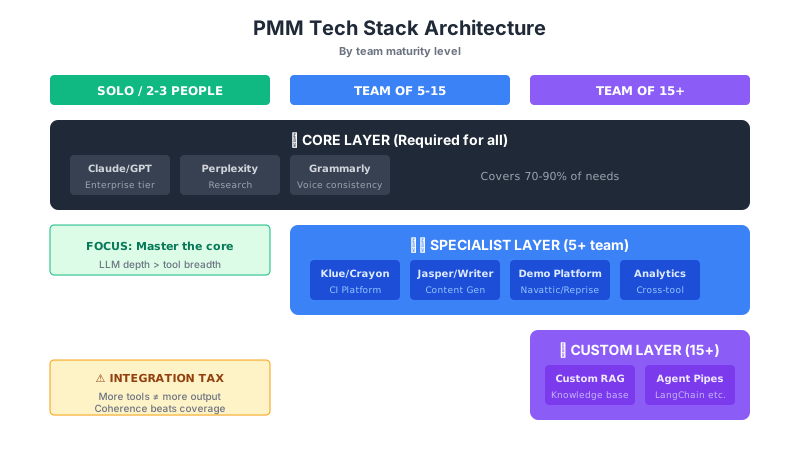
When you've validated the approach and need more firepower, consider dedicated CI platforms:
- Klue: Strong on battlecard management and sales integration
- Crayon: Excellent automated monitoring and AI-powered insights
- Kompyte: Good for high-volume monitoring across many competitors
- Gong: Win/loss intelligence from call recordings
These platforms handle the infrastructure so you can focus on strategy. But the principles are the same: collect, filter, synthesize, distribute.
Measuring CI Impact
Competitive intelligence is only valuable if it improves outcomes. Track these metrics:
- Competitive win rate: Are you winning more deals where competitors are present?
- Time to intelligence: How quickly do competitive moves reach sales?
- Battlecard usage: Is sales actually using the competitive content?
- Deal feedback: Do reps report feeling better prepared for competitive situations?
Ask your sales team: "When you're in a competitive deal, do you feel like you have current, actionable intelligence?" Their answer tells you whether your CI system is working.