Two types of evaluators increasingly determine whether your product makes the shortlist:
Industry analysts who use AI to accelerate their research, and AI agents that buying organizations deploy to pre-qualify vendors.
Both are reading your content differently than human evaluators did—and both reward a different kind of preparation.
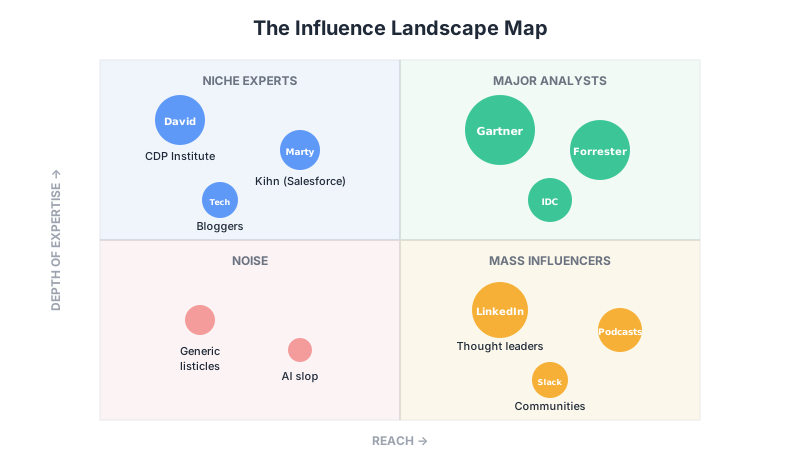
The AI-Augmented Analyst
Analysts at Gartner, Forrester, IDC, and boutique firms are using AI in their research.
They're not replacing their judgment with AI—but they're using AI to process more information faster, identify patterns across vendor data, and stress-test their assessments.
What does this mean for you?
Consistency Matters More
An analyst using AI to cross-reference your briefing materials against your public documentation will catch inconsistencies that a human analyst might miss.
If your briefing deck says you support 47 integrations but your website lists 42, the AI will flag it.
If your roadmap claims differ from your recent product announcements, the AI will surface the gap.
Before any analyst briefing, run your materials through an AI consistency check. Give Claude or GPT-4 your briefing deck and your public website content, and ask it to identify any claims that conflict or numbers that don't match.
Evidence Gets Verified
Claims you make in briefings now get cross-referenced against public sources.
"We're seeing 150% year-over-year growth" will be checked against your public statements, job postings, and any available financial data.
Customer claims get verified against case studies and references.
This isn't new—good analysts always verified claims. What's new is the speed and thoroughness of verification. AI makes it trivial to check everything, so analysts check everything.
Specificity Wins
Vague claims don't survive AI-augmented analysis.
"Industry-leading performance" gets flagged as unsubstantiated.
"Query response time averaging 180ms on benchmark datasets up to 50TB" can be evaluated against stated criteria and compared to competitors who provide similar specificity.
The analyst's AI assistant rewards the same things that buyer AI agents reward: specificity, evidence, structural coherence. Optimize for one and you optimize for both.
The Evaluation-First Buying Committee
Meanwhile, buying organizations are increasingly using AI agents to conduct initial vendor research.
Before the RFP, before the demo request, before any human engagement, an AI agent has likely already evaluated your product based on publicly available information.
This agent evaluation determines whether you make the long list—and often shapes the questions that come in the RFP.
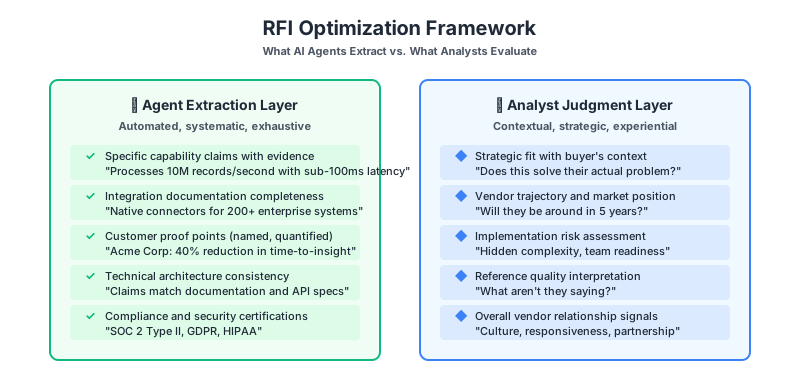
What Buyer Agents Evaluate
Based on testing with multiple AI models on vendor evaluation tasks, buyer agents typically assess:
- Requirement fit: Do stated capabilities match the buyer's specific requirements?
- Evidence quality: Are capability claims supported by verifiable evidence?
- Competitive position: How does this vendor compare to alternatives on key criteria?
- Risk signals: Are there red flags in documentation, reviews, or public information?
- Integration feasibility: Can this product work with the buyer's existing stack?
How to Win the Agent Evaluation
1. Provide structured comparison data.
Don't make the agent guess how you compare. Provide clear feature matrices, capability comparisons, and benchmark data that agents can extract and use directly.
2. Make evidence accessible.
Case studies, certifications, analyst recognitions, and customer proof should be publicly accessible—not behind registration walls that agents can't navigate.
3. Address common objections proactively.
If agents consistently surface the same concerns about your product category, address them explicitly in your public content.
4. Document integrations specifically.
Don't say "integrates with leading CRM systems." List the specific integrations, the integration methods, and the depth of integration for each.
5. Update regularly with timestamps.
Agents discount stale content. Clear publication and update dates signal that your information is current.
The Pre-Briefing AI Audit
Before any significant analyst briefing or sales engagement, conduct an AI audit:
- Run the agent evaluation. Ask Claude, ChatGPT, and Perplexity to evaluate your product for a typical use case. Document what they surface, cite, and flag.
- Identify gaps. Where is important information missing? Where are claims unsupported? Where do inconsistencies appear?
- Compare to competitors. Run the same evaluation for your top two competitors. Where do they outperform you in the agent's assessment?
- Close the gaps. Address the most damaging gaps before the engagement.
After a briefing, run the AI evaluation again. Did your position improve? If the agent assessment doesn't change, neither did the analyst's AI research—and your briefing may not have landed as well as you thought.
The Compounding Advantage
Here's what makes this strategic: success with AI evaluators compounds.
Good agent evaluations lead to more shortlist appearances, which lead to more customer wins, which generate more evidence, which improves future agent evaluations.
Conversely, poor agent evaluations mean fewer shortlist appearances, fewer wins, less evidence, and harder future evaluations.
The gap between vendors who optimize for AI evaluators and those who don't will widen over time.
Start now. The PMMs who figure this out early will have a compounding advantage that becomes increasingly difficult for competitors to overcome.