Learning Objectives
By the end of this unit, you will:
- Transform competitive intelligence from periodic review to persistent monitoring
- Expand win/loss analysis from sample-based to census-level coverage
- Build the "Living CI Architecture" with AI-powered synthesis
- Apply the practitioner's playbook for agent-powered competitive intelligence
Section 1: The CI Problem
~8 minDrowning in Data, Starving for Insight
Maria runs competitive intelligence for a mid-market data analytics company. She's responsible for tracking a dozen competitors across multiple product lines. Her team produces battlecards, runs win/loss programs, briefs sales teams, and feeds intelligence into roadmap discussions.
She's good at it. The problem? "Good at it" has a ceiling.
Her battlecards are accurate on publish day and slightly stale a week later. The win/loss analyses surface patterns but take weeks to produce. The competitive landscape shifts faster than any team can track — a competitor announces a partnership Tuesday, repositions Wednesday, and by Thursday their reps have new talking points Maria's team hasn't seen.
The Turning Point
So Maria built an AI-powered competitive monitoring system — a platform that transforms static competitive content into dynamic, always-current intelligence. The system ingests competitive data continuously and synthesizes it into deal-specific intelligence.
Now when a sales rep prepares for a call against a key competitor, they don't open a PDF battlecard. They query the system for what's changed in that competitor's positioning this week, what objections they'll face based on the prospect's industry, and how to reframe the conversation around their differentiated capabilities.
Key Insight
The gap between what Maria's team did before and what they do now isn't incremental — it's categorical. They didn't get faster at producing battlecards. They stopped producing static battlecards entirely. The artifact was replaced by a living system.
Section 2: From Periodic to Persistent
~10 minThe Traditional CI Cycle
Once a quarter, update the competitive landscape assessment. Review announcements, check analyst reports, talk to sales, produce a document. That document gets presented to leadership, distributed to sales, and then gradually decays in accuracy until the next quarterly refresh.
The problem: The cadence doesn't match the market. Competitive landscapes don't shift on a quarterly schedule. They shift when:
- A competitor announces a partnership with a major cloud provider
- A key rival drops pricing on a high-volume workload
- A competitor's CEO repositions their platform in a keynote
- A startup gets acquired and integrated into a major suite
Those signals don't wait for your quarterly review.
Traditional CI
- Quarterly review cycle
- Static battlecard PDFs
- Manual research & synthesis
- Decay in accuracy over time
- Reactive to market shifts
Agent-Powered CI
- Continuous monitoring
- Living, queryable systems
- AI-synthesized intelligence
- Always-current accuracy
- Proactive signal detection
The competitive intelligence that wins deals isn't the most comprehensive — it's the most current. The sales rep who knows about yesterday's competitor announcement beats the one still quoting last quarter's battlecard.
Section 3: The Living CI Architecture
~10 minThe Four-Layer System
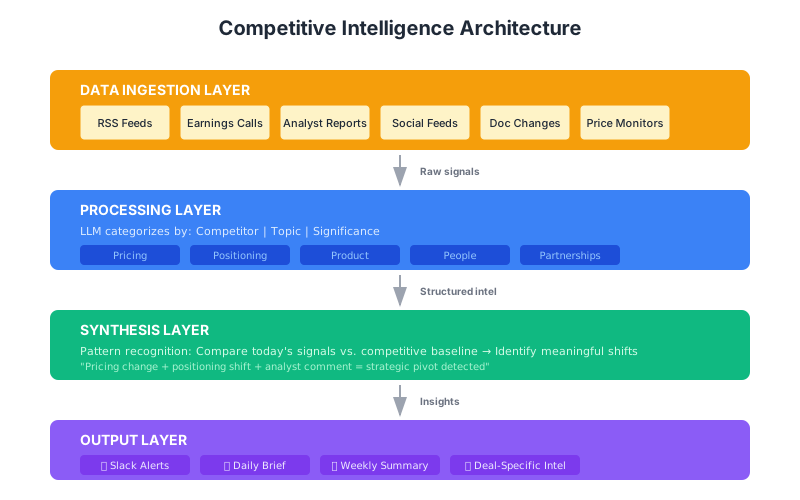
The architectural pattern is straightforward. Every PMM should understand how this works — even if you're not building it yourself, you need to know what's possible:
Data Ingestion
RSS feeds from competitor blogs, earnings call transcripts, analyst reports, social listening on exec accounts, product documentation changes, job postings, patent filings.
Processing Layer
LLM synthesizes raw signals into structured intelligence — categorizing by competitor, topic (pricing, positioning, product, people), and significance level.
Synthesis Layer
Agent compares today's signals against the competitive baseline and identifies meaningful shifts worth attention. Filters noise from signal.
Output Layer
Delivers intelligence in the right format: Slack alerts for urgent shifts, daily briefs for CI team, weekly summaries for leadership, deal-specific briefings for sales.
Why This Matters Now
None of these components are technically exotic. RSS feeds, monitoring tools — they existed before AI. The difference is the synthesis layer.
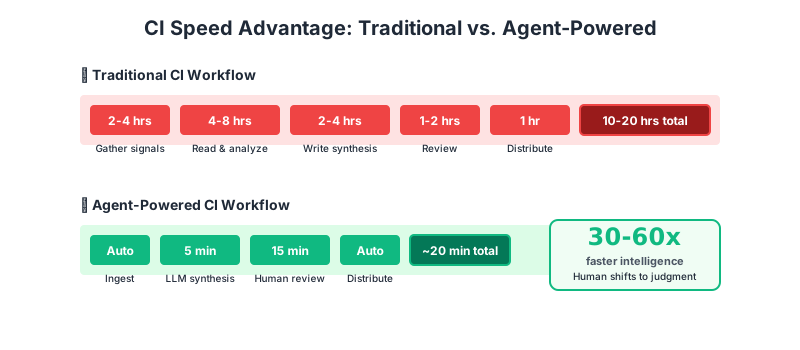
Before LLMs, gathering signals was easy but making sense of them required a human analyst with deep domain knowledge and lots of time. Now an agent produces first-pass synthesis in minutes, and the analyst's job shifts from "what happened?" to "what should we do about it?"
Section 4: Win/Loss at Census Scale
~10 minThe Sample Problem
Win/loss has always been one of the highest-value, lowest-frequency PMM activities. Understanding why you won and lost is the most direct input into positioning, messaging, competitive strategy, and roadmap priorities.
The traditional problem: Structured interviews covering 10-20 deals per quarter out of a pipeline of 200. That's 10% coverage at best. And selection bias skews toward deals sales is willing to discuss — usually the wins and the "clean" losses, not the messy ones where competitive intelligence would help most.
Agent-Augmented Win/Loss
An agent can process every deal in your CRM — not just the ones you have time to interview. It reads:
- Call notes and email threads
- Conversation intelligence transcripts (Gong, Chorus, etc.)
- Opportunity field data and timeline progression
- Competitor mentions and objection patterns
It identifies patterns a human reviewing 20 deals would never see:
- Deals against Competitor X have 40% longer sales cycles when the tech evaluator is from a specific department
- Win rate drops 15 points when the prospect previously used a specific competitive product
- Pricing objections correlate with deal size in a non-linear way your discounting model doesn't account for
- Specific feature gaps only surface in enterprise deals above $500K
The agent doesn't replace the win/loss interview — it transforms what you ask. Instead of spending 30 minutes understanding what happened, you spend 30 minutes understanding why — because the agent already synthesized the what.
Section 5: The Practitioner's Playbook
~7 minWhere to Start
If you're thinking "this sounds great but where do I start?" — here's what works:
1. Start with the Daily Brief
Don't build the full monitoring system first. Every morning, prompt Claude or ChatGPT to synthesize latest news for your top 3 competitors. Categorize by positioning, pricing, product, people. Flag meaningful shifts. Get 80% of value in a day.
2. Win/Loss Synthesis First
Export 2 quarters of closed deals from CRM with all field data and notes. Run through your LLM asking for pattern identification. The output surfaces patterns you didn't know existed — and proves the value to leadership.
3. Distribution Before Intelligence
The best CI is worthless in a Notion doc nobody reads. Figure out delivery first: Slack alerts, CRM integrations, deal-specific briefings. Distribution turns intelligence into action.
The Leadership Pitch
CI in most organizations is underfunded and underwhelming — often one person or a shared responsibility getting 10% attention. Agent-powered CI breaks that cycle because the output changes so dramatically that leadership notices.
Our advice: Don't ask for permission. Build it on a small scale — 3 competitors, one product line, a daily brief to your sales team — and let the results speak. A working prototype beats a strategy memo every time.
Key Takeaways
- Always-on beats quarterly: Competitive monitoring should match market velocity, not calendar cadence
- Living systems replace static artifacts: Queryable intelligence beats PDF battlecards
- Census beats sample: Agent-augmented win/loss covers every deal, not just 10%
- Build first, pitch second: A working prototype beats a strategy memo every time
- Distribution is the bottleneck: Build the delivery mechanism before the intelligence