Learning Objectives
By the end of this unit, you will:
- Understand why enterprise marketing is being transformed, with data from McKinsey, Gartner, and Forrester
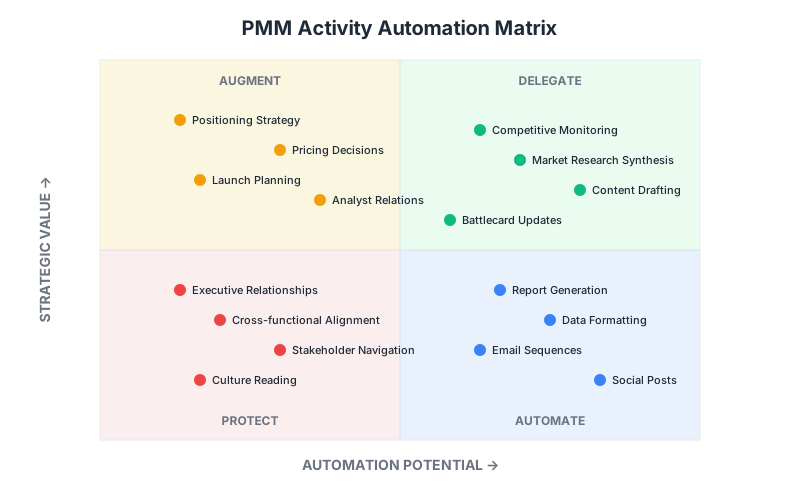
- Analyze PMM activities against an AI impact matrix — identifying which tasks to automate, augment, or elevate
- Map the new "agentic" buyer funnel where both humans and AI agents make purchasing decisions
- Define the "10x PMM" model and create your personal development roadmap
Section 1: The Transformation Underway
~12 minThe Questions Have Changed
When AI training programs started rolling out across enterprise marketing teams, the questions were tactical: "Which AI should I use?" "How do I write better prompts?" Today, the questions are existential: "How do I stay relevant?" "What should I actually be focusing on?"
These aren't idle concerns. PMMs who don't adapt to AI-augmented workflows risk falling behind, while those who master them will become indispensable. The speed of change has surprised everyone — not long ago, we were debating whether AI could write passable first drafts. Today, AI is a working partner across the entire PMM workflow.
The Core Thesis
The "10x PMM" isn't someone who uses AI tools to do the same job faster. It's someone who builds a co-working relationship with AI that fundamentally changes what's possible — adapting to a new funnel, a new buyer, and a new way of working.
What the Research Shows
This isn't speculation. The world's leading analysts are documenting the same shift with hard data.
McKinsey's "State of Marketing" survey revealed a widening divide. The top 6% of companies — the "AI high performers" — achieve 22% efficiency gains through new working methods. The rest are falling behind. Gartner forecasts $6.15 trillion in global IT spending for 2026, with enterprise software growing at 15.2% — the fastest segment.
What This Means
Enterprise marketing isn't shrinking — it's being rewired with AI as the central power source. Teams that adapt their approach will capture the growth. Teams doing 2020-era PMM will lose ground to competitors who've made the shift.
Section 2: The AI Impact Matrix
~12 minWhere AI Changes the Game
Not all PMM work is affected equally. We analyzed activities against three criteria:
- Can current AI execute this at 80%+ of human quality?
- What's the cost and speed differential?
- How does this change what "good" looks like?
The results reveal a clear pattern: the activities that consume most of our time are exactly where AI has the greatest impact. This isn't a threat — it's an opportunity. When AI handles volume work, we get time back for strategic work that actually moves the needle.
AI Impact by Activity
| Activity | AI Impact | Level |
|---|---|---|
| First-draft content (blog, email, ad copy) | 94% | HIGH IMPACT |
| Basic competitive research | 91% | HIGH IMPACT |
| Template-driven sales enablement | 88% | HIGH IMPACT |
| Standard RFP responses | 85% | HIGH IMPACT |
| Market sizing / TAM analysis | 82% | HIGH IMPACT |
| Social & campaign copy | 79% | MODERATE |
| Win/loss interview synthesis | 75% | MODERATE |
| Product launch checklists | 72% | MODERATE |
| Analyst briefing prep | 65% | MODERATE |
| Demo scripting | 54% | EVOLVING |
| Customer interview synthesis | 42% | LOWER |
| Competitive strategy & positioning | 28% | HUMAN-LED |
| Narrative architecture | 18% | HUMAN-LED |
| Category creation & market framing | 12% | HUMAN-LED |
| Executive communication & influence | 9% | HUMAN-LED |
The Key Insight
Look at the pattern: high-volume production work (drafting, research, templates) has 80%+ AI impact. Strategic work (positioning, narrative, executive influence) remains firmly human-led at under 30%.
The opportunity: When AI handles the 80% work, you get time back for the 20% work that actually differentiates careers.
The Two Modes of PMM Work
Understanding this distinction is fundamental to the 10x PMM model:
| Production Work (AI-Accelerated) | Strategic Work (Human-Led, AI-Augmented) |
|---|---|
| First-draft content Blog posts, emails, ad copy, social | Narrative architecture Making complex products feel like obvious choices |
| Basic research Competitive monitoring, market sizing | Competitive strategy Pattern recognition from years of market immersion |
| Template enablement Battlecards, RFP boilerplate | Category creation Naming new markets, building authority |
| Production copy Localization, versioning, adaptation | Executive communication Influencing C-Suite with incomplete data |
Real-World Example: Competitive Battlecard
Old Way: You spend 4-6 hours researching a competitor — scanning their website, reading analyst reports, compiling win/loss notes — then 2-3 more hours writing. Total: 8+ hours.
10x PMM Way: Give AI your competitive framework and ask it to pull the latest across public sources. In 15 minutes you have a draft with cited sources. Spend 1-2 hours adding your strategic insights — the "why we win" narrative, objection handlers from actual deal experience. Total: ~2 hours, better battlecard.
The difference: AI accelerated the research and first draft. You augmented it with judgment and strategy.
Section 3: The AI-Mediated Buyer Journey
~12 minHow Buyers Move Today
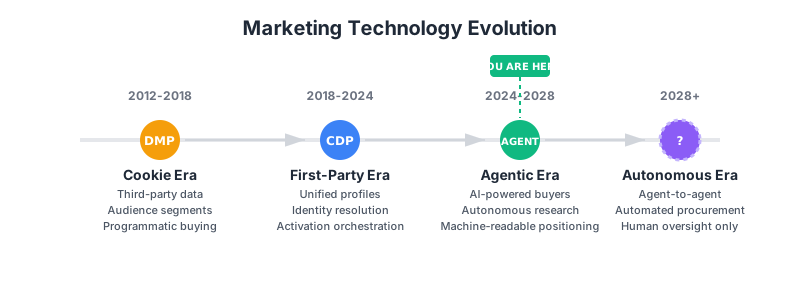
The B2B buying journey hasn't changed in structure — awareness → consideration → decision. What's changed is HOW buyers move through each stage. Increasingly, AI assistants mediate every step.
Stage 1: AWARENESS
"What solutions exist for my problem?"
What's changed: Buyers start with AI assistants and search tools rather than going directly to vendor websites. When someone asks Claude or ChatGPT "What's the best CRM for a 50-person sales team?", they get a synthesized answer — not a list of links to click.
| PMM Activity | AI Impact | Your Adaptation |
|---|---|---|
| Market Research | 82% | Focus on insight synthesis, not data gathering |
| Content Strategy | 79% | Optimize for AI discoverability, not just SEO |
| Thought Leadership | 65% | Build authority through substance, not volume |
Stage 2: CONSIDERATION
"Which vendors should I shortlist?"
What's changed: Buyers get vendor comparisons from AI before visiting your site. Your positioning needs to be clear enough that it comes through accurately when summarized. You're now writing for two audiences: humans AND AI agents.
| PMM Activity | AI Impact | Your Adaptation |
|---|---|---|
| Positioning & Messaging | 28% | Must survive summarization — crisp, quotable |
| Competitive Differentiation | 28% | Clear, verifiable differences that AI can cite |
| Analyst Relations | 65% | Analysts shape AI discovery — invest here |
Stage 3: EVALUATION
"Does this solution actually work for us?"
What's changed: AI agents do homework on vendors. They develop RFI/RFPs, manage initial evaluation, create shortlists, and arm procurement with questions. Vision-only marketing becomes harder — AI-assisted buyers validate claims against capabilities, reviews, and third-party data.
| PMM Activity | AI Impact | Your Adaptation |
|---|---|---|
| Sales Enablement | 88% | Structured, searchable — not just PDFs |
| Technical Content | 75% | Comprehensive enough for deep questions |
| Demo Strategy | 54% | Self-service options for technical validation |
The Visibility Gap
Here's the uncomfortable truth: your content might rank on Google but be invisible to AI. Traditional SEO (Search Engine Optimization) is different from GEO (Generative Engine Optimization).
If AI assistants can't parse, summarize, and cite your content, you don't exist in the new buyer journey. This curriculum teaches you how to close that gap.
Section 4: Becoming the 10x PMM
~9 minWhat 10x Actually Means
The "10x PMM" isn't about working faster. It's about working differently. It's someone who:
- Automates production work — AI handles first drafts, research compilation, template generation
- Augments strategic work — AI surfaces patterns, stress-tests positioning, simulates objections
- Elevates human judgment — Narrative, relationships, and executive influence become more valuable
In production work, AI handles the first draft, initial research, and templates. You become the director and editor — faster output, higher quality, because you're focused on judgment, not mechanics.
In strategic work, AI augments your thinking — surfacing patterns you'd miss, stress-testing your positioning, simulating stakeholder objections. You still lead, but with better inputs.
The Three Horizons
| Horizon | Focus | Timeline |
|---|---|---|
| H1: Accelerate | Use AI for drafts, research, templates. Get 3-5x faster on production work. | Weeks 1-4 |
| H2: Augment | Build AI workflows for strategy — positioning tests, competitive analysis, message variants. | Months 2-3 |
| H3: Architect | Design AI-native systems — always-on competitive intel, content engines, enablement platforms. | Months 4-6 |
Your Development Path
This curriculum follows the three horizons. Units 2-6 focus on accelerating and augmenting core PMM workflows. Units 7-11 cover advanced applications. Unit 12 synthesizes everything into your personal transformation plan.
What Comes Next
In the following units, you'll learn:
- Unit 2: Messaging for two audiences — humans and AI agents
- Unit 3: Building always-on competitive intelligence systems
- Unit 4: Winning with analysts and AI evaluators
- Unit 5: Transforming sales enablement with the intelligence layer
- Unit 6: Launching at 10x speed with AI coordination
Each unit includes hands-on labs where you'll apply the concepts with real AI tools, building artifacts you can use immediately in your work.