Learning Objectives
By the end of this unit, you will:
- Build messaging frameworks optimized for AI discoverability
- Understand how AI evaluates and surfaces competitive claims
- Create positioning that earns citations in AI-generated responses
- Test messaging effectiveness across human and AI audiences
Section 1: The Two-Audience Problem
~10 minWriting for Humans and Machines
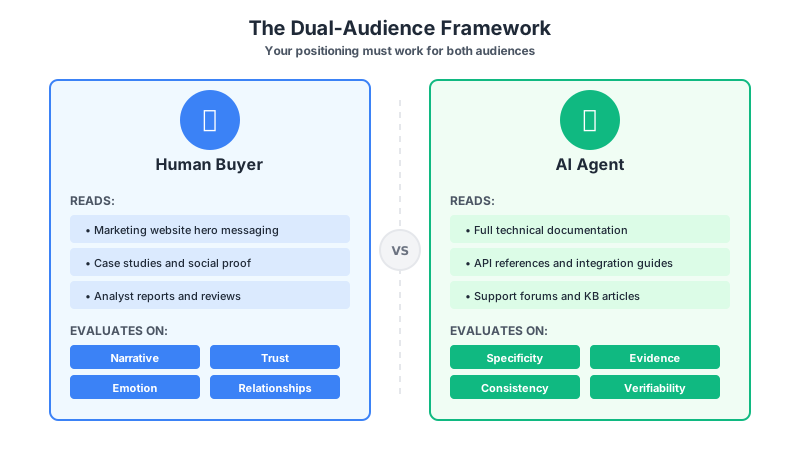
Every piece of content you create now serves two audiences: humans and machines. This isn't a future state — it's the current reality, and most PMM teams are still writing exclusively for the first audience while ignoring the second.
When you craft a positioning statement, a human reader processes it through emotional resonance, brand affinity, and personal relevance. They might not remember your exact words, but they'll remember how you made them feel. Traditional messaging guidance optimizes for this: be memorable, be differentiated, create an emotional connection.
But an AI reading that same statement is doing something different. It's evaluating semantic content. It's cross-referencing claims against other sources. It's assessing specificity, looking for verifiable details, and deciding whether to cite you in a synthesized response or pass over you for a competitor who made a more concrete claim.
Fails Both Audiences
"Empowering Digital Transformation"
Works for Both
"Teams complete quarterly close 40% faster, with audit findings reduced by 65% in year one."
The vague claim might resonate emotionally with an executive tired of legacy systems. But it gives an AI nothing to work with. No specificity. No verifiable claim. No differentiation from the thousand other vendors who say the same thing.
The Core Challenge
These two optimization targets don't always conflict — but they often do. The 10x PMM solves the two-audience problem by creating messaging that works for both: emotionally resonant for humans, informationally dense for machines.
Section 2: The Specificity Imperative
~10 minVague Claims Vanish
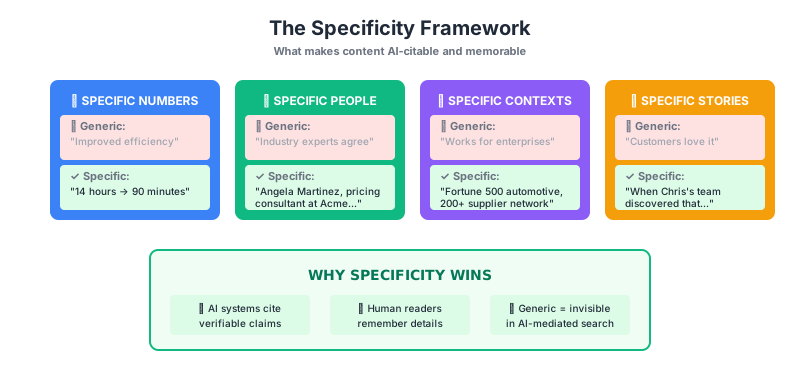
The single biggest shift in messaging strategy for the AI era is the move from vague to specific. Compare these two value propositions:
Vague
"Our platform helps teams work faster and smarter."
Specific
"Teams using our platform complete quarterly close 40% faster, with audit findings reduced by 65% in the first year."
The vague claim is technically true of every software product ever built. It provides no differentiation. When an AI agent is asked to compare accounting platforms, it has nothing to cite.
The specific claim gives the AI something to surface. It includes numbers. It implies verifiable outcomes. It can be cross-referenced. And crucially, it can be used in a comparison: "Platform A cites 40% faster quarterly close; Platform B does not provide comparable metrics."
The Specificity Ladder
Think of specificity as a ladder with five rungs. Most B2B messaging lives at level 2 or 3. The companies winning the AI visibility game operate at level 4 and 5:
Abstract
Zero specificity — completely invisible to AI
"We make things better."Categorical
Category-level — AI surfaces but doesn't differentiate
"We improve productivity."Directional
Audience-specific — AI can filter to relevant queries
"We improve productivity for sales teams."Quantitative
Measurable — AI can compare against competitors
"We improve sales productivity by 30%."Evidenced
Verifiable — AI trusts and cites confidently
"We improve sales productivity by 30%, based on a 2025 study of 200 deployments."The New PMM Skill
This requires a cultural shift in how PMMs work with stakeholders. When a product manager says "our new feature improves performance," your job is to push: "By how much? In what conditions? Can we measure it? Can we publish it?" That negotiation becomes a core PMM competency.
Section 3: Claims That Get Cited
~10 minThe Citation Hierarchy
Not all claims are created equal in the eyes of AI. There's a clear hierarchy that determines what gets cited versus what gets ignored:
| Claim Type | AI Treatment | Example |
|---|---|---|
| Third-party validated | Highest trust, frequent citation | "Named a Leader in Gartner Magic Quadrant" |
| Customer-attributed | High trust, cited with attribution | "Acme Corp reduced costs 40%" |
| Published research | Medium-high trust | "Based on analysis of 500 deployments" |
| Quantified internal | Medium trust, cited carefully | "Average customer sees 30% improvement" |
| Unquantified claims | Low trust, rarely cited | "Industry-leading performance" |
| Superlatives | Ignored entirely | "Best-in-class solution" |
Building a Citation Portfolio
Treat your claims like a portfolio. You need a mix:
- Anchor claims: 2-3 third-party validated proof points that establish category credibility
- Proof points: 5-10 customer-attributed outcomes with specific metrics
- Differentiators: 3-5 quantified claims that separate you from competitors
- Narrative: Emotional, human-focused messaging that wraps the proof in story
The narrative is for humans. The proof points are for AI. You need both.
Section 4: The Dual-Optimized Framework
~12 minBuilding Messaging That Works Twice
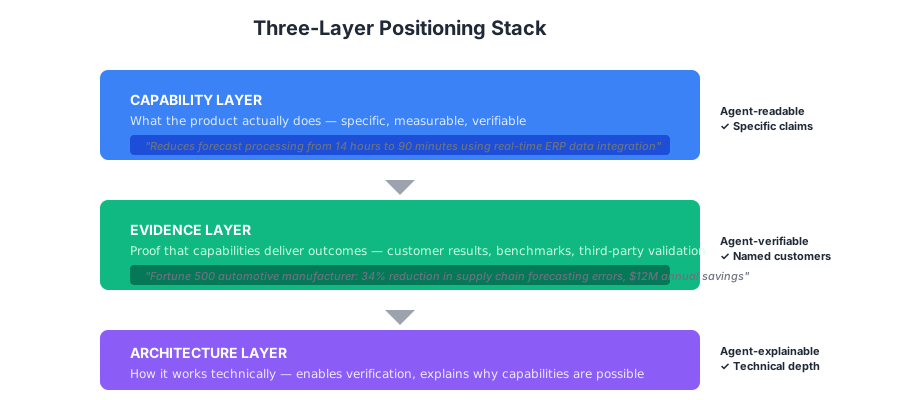
Here's a practical framework for creating messaging that serves both audiences:
1. Start with the Claim
What specific, verifiable outcome can you promise? Not what you do — what happens when customers use you. Push for numbers.
2. Add the Evidence
Where does this claim come from? Customer name? Sample size? Time period? The more specific, the more citable.
3. Wrap in Story
Now add the human element. Who cares about this outcome? Why does it matter? What transformation does it enable?
4. Test Both Paths
Ask Claude or ChatGPT to compare you to competitors. Does your claim surface? Is it cited accurately? Iterate until it does.
Before & After Example
Before: "Our AI-powered platform helps finance teams work more efficiently and reduce errors."
After: "Finance teams using our platform close quarterly books 40% faster. In a 2025 study of 200 customers, average audit findings dropped 65% in year one — with CFOs reporting they finally have time for strategic work instead of spreadsheet wrangling."
Why it works: The "After" version has specific metrics for AI to cite AND emotional resonance ("finally have time for strategic work") for humans to connect with.
Section 5: Testing Your Messaging
~8 minThe AI Visibility Test
Here's a simple test you should run on all key messaging:
- Ask an AI to compare: "Compare [Your Product] to [Competitor] for [Use Case]"
- Check the output: Are your claims cited? Accurately? With the specificity you intended?
- Identify gaps: What did the competitor say that you didn't? What claims got attributed to you that you don't own?
- Iterate: Strengthen claims that didn't surface. Add evidence to claims that surfaced weakly.
Warning: The Training Data Gap
AI models are trained on historical data. Your latest messaging might not be in the training set. This means you need to ensure your claims appear in multiple authoritative sources — your website, analyst reports, press coverage, customer reviews — not just internal docs.
Key Takeaways
- Two audiences, one message: Every piece of content must work for humans AND AI
- Specificity wins: Move from abstract to evidenced claims (levels 4-5)
- Citations matter: Third-party and customer-attributed claims get cited most
- Test constantly: Ask AI to compare you to competitors and iterate based on what surfaces
- Story wraps evidence: Specific claims for AI, emotional narrative for humans